# Identity of the series in the product file.
#
# The product carries the series twice: as the instrument reported it, and with the pre-2016 era
# raised onto the level of the post-2016 era. Nearly every statistic in this notebook compares
# years across the 21 January 2016 sensor change, so the homogenised column is the default and the
# measured one is kept beside it for the sections that report what was actually recorded.
varname = 'TA_T1_47_1_HOMOGENIZED_gfXG'  # used for everything unless stated otherwise
varname_measured = 'TA_T1_47_1_gfXG'  # what the instrument reported, not homogeneous across 2016
flagname = 'FLAG_TA_T1_47_1_ISFILLED'
sourcename = 'FLAG_TA_T1_47_1_SOURCE'
var = "TA"  # Name shown in plots
units = "°C"

# What the fill flag codes mean, taken from the notebook that produced the product
# (10_METEO/30_PRODUCTS/02). Used in the coverage section. There is no code 3: that is the
# nighttime-zero branch of the SW_IN gap-filler and does not apply to temperature.
FLAG_LEGEND = {
    0: 'measured',
    1: 'XGBoost model',
    2: 'timestamp-only fallback model',
    4: 'linear interpolation (short gap)',
    5: 'reconstructed from NABEL at 49 m',
}

# Which instrument a record belongs to. Codes 2 and 3 mark records that no sensor produced.
FLAG_SOURCE_LEGEND = {
    0: 'Campbell CS215, SDI-12 (from 21 Jan 2016)',
    1: 'Rotronic MP101A, analog (to 31 Dec 2015)',
    2: 'acquisition changeover, era undetermined',
    3: 'before the tower record begins',
}

# Period covered by this overview. The product itself starts in 2004, but 2004 is incomplete: the
# tower record begins on 20 September 2004, so 72 % of that year is modelled and its level is set
# by the reconstruction rather than measured.
FIRST_YEAR = 2005
LAST_YEAR = 2025

# Analysis parameters.
N_RECENT_YEARS = 10  # length of the recent period in the period means
N_RANKED = 5  # number of years listed as warmest and coolest
N_EXTREMES = 10  # number of records listed in the extremes tables
REFERENCE_START_YEAR = FIRST_YEAR  # reference period for all anomalies
REFERENCE_END_YEAR = LAST_YEAR

# Site coordinates and timezone, used to compute potential radiation for the night/day split in
# the reference comparison. Potential radiation depends on nothing but the clock and the location,
# so that split introduces no further measurement. Same values as 10_METEO/30_PRODUCTS.
SITE_LAT = 47.478333  # CH-LAE
SITE_LON = 8.364389
TIMEZONE_OFFSET_TO_UTC_HOURS = 1  # CET (winter time), the timezone the product is stored in

# Physical limits for the integrity check. Wide on purpose: they catch a broken unit or a failed
# gap-filling, not an unusual day.
LIMITS = (-40.0, 45.0)

# The appendix draws two figures per year. Switch it off for a quick run.
SHOW_PER_YEAR_DETAIL = TrueMeteo: Air temperature (TA) (2005-2025)
Author: Lukas Hörtnagl (holukas@ethz.ch)
About this notebook
Overview of the gap-filled air temperature product of CH-LAE. The product is produced by 10_METEO/30_PRODUCTS/02_METEO_TA_2004-2025.ipynb; this notebook computes and corrects nothing, it only describes what was exported.
The 47 m record spans two instruments. On 21 January 2016 the sensor and its acquisition system were replaced together — a Rotronic MP101A read as a single-ended analog voltage gave way to a Campbell CS215 on SDI-12 — and the earlier chain carried a constant zero-point error of about -11 mV, so the pre-2016 record reads about 1.3 °C too cold. The product therefore exports the series twice.
Columns of the product
TA_T1_47_1_gfXG— air temperature (°C), continuous, gap-filled, as the instrument reported. Not homogeneous across 21 January 2016TA_T1_47_1_HOMOGENIZED_gfXG— the same series made comparable across the break by two corrections: the earlier era is raised onto the level of the later one, and the later era’s radiation-shield error is reduced onto the earlier one’s. Use this column for anything that crosses January 2016FLAG_TA_T1_47_1_ISFILLED—0= measured,1= XGBoost model,2= timestamp-only fallback model,4= linear interpolation of a short gap,5= reconstructed from NABEL at 49 m on the same tower. There is no code3FLAG_TA_T1_47_1_SOURCE—0= Campbell CS215 era,1= Rotronic MP101A era,2= the January 2016 changeover, sensor era undetermined,3= before the tower record begins in September 2004
Which column this notebook uses. Almost everything below compares years with one another, and a comparison that crosses January 2016 on the measured column reports the instrument rather than the climate — the period means in Summary statistics show how much of the apparent warming is the sensor. The homogenised column is therefore used throughout, and the measured column appears only where the point is to report what the instrument recorded. Every table and figure states which of the two it used.
NoteThe correction covers the level and most of the shape
The two sensors had different radiation shields, and that difference acts in daylight. The correction removes the level difference and most of the shield difference as well, so daily maxima and diurnal ranges are far closer across the break than the measured column makes them — but not identical. What the correction does to the shape of the day measures the residual step in each daily statistic on every run; read it before comparing daily maxima, diurnal ranges or threshold-day counts across January 2016.
Timestamps. The product is stored on TIMESTAMP_MIDDLE at 30 minutes, so a record labelled 16:45 is the average over 16:30 to 17:00. Wherever a single record is quoted below, its averaging window is reported instead of its timestamp.
Two conventions used throughout
- Extremes are taken from measured records only. A gap-filled value is a model result and cannot set a record. Means, counts and indices use the full series, which is why the gap-filled share of each year is reported before any statistic.
- Yearly means are means of yearly means. The overall mean averages the yearly means, so every year carries the same weight. The mean over all records is printed next to it for comparison.
Settings
Imports
import calendar
import importlib.metadata
import textwrap
import warnings
from datetime import datetime
from pathlib import Path

import numpy as np
import pandas as pd
import matplotlib.pyplot as plt
import matplotlib.gridspec as gridspec
from matplotlib.colors import Normalize
from scipy.stats import kendalltau, theilslopes

import diive as dv
from diive.core.io.files import save_parquet, load_parquet
from diive.core.plotting.cumulative import CumulativeYear
from diive.core.plotting.bar import LongtermAnomaliesYear

warnings.filterwarnings(action='ignore', category=FutureWarning)
warnings.filterwarnings(action='ignore', category=UserWarning)
version_diive = importlib.metadata.version("diive")
print(f"diive version: v{version_diive}")
diive version: v0.91.0Helpers
def per_year(s, how='mean'):
    """Aggregate `s` to one value per year, indexed by the year number instead of by a timestamp."""
    out = s.resample('YE').agg(how)
    out.index = out.index.year
    out.index.name = 'YEAR'
    return out


def per_year_month(s, how='mean', month_names=True):
    """Aggregate `s` to a table of YEAR (rows) by MONTH (columns)."""
    out = s.groupby([s.index.year, s.index.month]).agg(how).unstack()
    out.index.name = 'YEAR'
    if month_names:
        out.columns = [calendar.month_abbr[m] for m in out.columns]
    return out


def tabcap(text, width=100):
    """Print a table caption. Called by `styled`, so no table can be shown without one."""
    print(textwrap.fill(f"Table — {text}", width) + "\n")


def figcap(fig, text, width=125):
    """Place a caption under a figure. Call after the last axes of that figure is drawn.

    A figure drawn with a layout engine makes room for a caption by itself. The figures pandas and
    diive build have no engine, and a caption placed in them lands on top of the tick labels. For
    those the figure is extended downwards by the height of the caption and every axes is moved up
    by the same amount, so the drawing keeps its size and position and the caption gets a free
    strip below it. `width` is the widest the caption may wrap, narrowed for a narrow figure.
    """
    # A fixed wrap width runs off the side of a narrow figure, so it is capped by how many
    # characters of this font size fit across the figure.
    width = min(width, max(40, int(14.5 * fig.get_size_inches()[0])))
    caption = textwrap.fill(f"Figure — {text}", width)
    # An engine that still lays the figure out at draw time can make room for a caption itself.
    # plt.tight_layout() does NOT leave one: it executes once and leaves a PlaceHolderLayoutEngine
    # that never runs again, so a caption handed to supxlabel there lands on top of the tick
    # labels. Those figures take the manual branch below.
    _engine = fig.get_layout_engine()
    if _engine is not None and type(_engine).__name__ != 'PlaceHolderLayoutEngine':
        fig.supxlabel(caption, fontsize=9, ha='left', x=0.005)
        return
    lines = len(caption.splitlines())
    extra = 0.17 * lines + 0.12  # inches, one caption line is about 0.17 in at fontsize 9
    width_in, height_in = fig.get_size_inches()
    fig.set_size_inches(width_in, height_in + extra)
    keep = height_in / (height_in + extra)  # the old figure as a fraction of the new one
    offset = extra / (height_in + extra)
    for ax in fig.axes:
        pos = ax.get_position()
        ax.set_position([pos.x0, offset + pos.y0 * keep, pos.width, pos.height * keep])
    fig.text(0.005, 0.01, caption, fontsize=9, ha='left', va='bottom')


def window(tsmid):
    """The averaging window of a 30MIN record stored on TIMESTAMP_MIDDLE, as text."""
    start = tsmid - pd.Timedelta('15min')
    end = tsmid + pd.Timedelta('15min')
    return f"{start:%d %b %Y}, {start:%H:%M} to {end:%H:%M}"


def styled(data, caption, fmt="{:.1f}", subset=None, cmap="RdYlBu_r", axis=0, center=False):
    """`data` as a table with a caption, fixed decimals and a colour scale over its values.

    The caption is printed above the table, so it is written as a sentence about what the table
    shows rather than as a title. `center` puts the midpoint of the colour scale at zero, and
    `axis=None` scales the colours across the whole table instead of column by column. The colour
    scale sets a text colour per cell, so the numbers stay readable in both the light and the dark
    version of the rendered page.
    """
    # Formats apply to numbers only, so text columns are dropped from the map. Without this a
    # table carrying a date or a label raises at render time, not at call time.
    numeric = [c for c in data.columns if pd.api.types.is_numeric_dtype(data[c])]
    fmt = {c: fmt for c in numeric} if isinstance(fmt, str) else {
        c: f for c, f in fmt.items() if c in numeric}
    tabcap(caption)
    styler = data.style.format(fmt, na_rep="-")
    if cmap is None:
        return styler
    limits = {}
    if center:
        values = data[subset] if subset is not None else data
        absmax = np.nanmax(np.abs(values.to_numpy(dtype=float)))
        limits = dict(vmin=-absmax, vmax=absmax)
    return styler.background_gradient(cmap=cmap, subset=subset, axis=axis,
                                      text_color_threshold=0.4, **limits)


def anomaly_bars(styler, column):
    """Draw in-cell bars for an anomaly column, in the colours of the anomaly plots."""
    return styler.bar(subset=[column], align='zero', color=['#42A5F5', '#EF5350'])


def trend(yearly):
    """Theil-Sen slope per decade of a yearly series, with its 95 % interval and Kendall's tau.

    Theil-Sen rather than least squares because a single extreme year does not move it, and
    Kendall's tau because it tests a monotonic trend without assuming normal residuals.
    """
    years = yearly.index.to_numpy(dtype=float)
    values = yearly.to_numpy(dtype=float)
    slope, intercept, low, high = theilslopes(values, years, alpha=0.95)
    tau, pvalue = kendalltau(years, values)
    return dict(slope=slope * 10, low=low * 10, high=high * 10, tau=tau, pvalue=pvalue,
                fit=pd.Series(intercept + slope * years, index=yearly.index))


def longest_spell(mask):
    """Length in days and start date of the longest run of True in a daily boolean series."""
    blocks = mask.ne(mask.shift()).cumsum()
    runs = mask[mask].groupby(blocks[mask]).size()
    if runs.empty:
        return 0, pd.NaT
    return int(runs.max()), mask.index[blocks == runs.idxmax()][0]


def growing_season(daily_mean, base=5.0, span=6):
    """Start, end and length of the growing season of one year.

    Definition used here: the season starts on the first day of the first `span` consecutive days
    with a daily mean above `base`, and ends on the first day of the first such span below `base`
    after 1 July. Several conventions are in use, so the numbers only mean something together with
    this definition.
    """
    above = daily_mean > base
    runs = above.rolling(span).sum()
    starts = runs[runs == span]
    if starts.empty:
        return None
    start = starts.index[0] - pd.Timedelta(days=span - 1)
    second_half = (~above).loc[f"{daily_mean.index[0].year}-07-01":]
    runs_below = second_half.rolling(span).sum()
    ends = runs_below[runs_below == span]
    end = ends.index[0] - pd.Timedelta(days=span - 1) if not ends.empty else daily_mean.index[-1]
    return dict(start=start, end=end, length=(end - start).days)
Load data
# Gap-filled TA produced by notebook 10_METEO/30_PRODUCTS/02. Data files live in the external
# (untracked) data folder, mirroring the workflow tree of this repo.
SOURCEDIR = r"F:\Sync\luhk_work\dev-data\datasets-data\dataset_ch-lae_flux_product-data\workflow\10_METEO\30_PRODUCTS"
FILENAME = r"02_METEO_TA_GAPFILLED_2004-2025.parquet"
FILEPATH = Path(SOURCEDIR) / FILENAME
df = load_parquet(filepath=FILEPATH)

# The source product starts in 2004, this overview covers FIRST_YEAR to LAST_YEAR.
keeplocs = (df.index.year >= FIRST_YEAR) & (df.index.year <= LAST_YEAR)
df = df[keeplocs].copy()

print(f"Columns: {list(df.columns)}")
print(f"Range:   {df.index[0]} -> {df.index[-1]} ({len(df):,} records)")
df
> Loaded .parquet file
F:\Sync\luhk_work\dev-data\datasets-data\dataset_ch-lae_flux_product-data\workflow\10_METEO\30_PRODU
CTS\02_METEO_TA_GAPFILLED_2004-2025.parquet (0.034 seconds).
Columns: ['TA_T1_47_1_gfXG', 'FLAG_TA_T1_47_1_ISFILLED', 'TA_T1_47_1_HOMOGENIZED_gfXG', 'FLAG_TA_T1_47_1_SOURCE']
Range: 2005-01-01 00:15:00 -> 2025-12-31 23:45:00 (368,160 records)| TA_T1_47_1_gfXG | FLAG_TA_T1_47_1_ISFILLED | TA_T1_47_1_HOMOGENIZED_gfXG | FLAG_TA_T1_47_1_SOURCE | |
|---|---|---|---|---|
| TIMESTAMP_MIDDLE | ||||
| 2005-01-01 00:15:00 | -2.160000 | 0 | -0.840326 | 1 |
| 2005-01-01 00:45:00 | -2.010000 | 0 | -0.690326 | 1 |
| 2005-01-01 01:15:00 | -1.791000 | 0 | -0.471326 | 1 |
| 2005-01-01 01:45:00 | -1.539000 | 0 | -0.219326 | 1 |
| 2005-01-01 02:15:00 | -1.338000 | 0 | -0.018326 | 1 |
| ... | ... | ... | ... | ... |
| 2025-12-31 21:45:00 | -3.081644 | 0 | -3.081644 | 0 |
| 2025-12-31 22:15:00 | -3.084372 | 0 | -3.084372 | 0 |
| 2025-12-31 22:45:00 | -3.423939 | 0 | -3.423939 | 0 |
| 2025-12-31 23:15:00 | -3.437078 | 0 | -3.437078 | 0 |
| 2025-12-31 23:45:00 | -3.546789 | 0 | -3.546789 | 0 |
368160 rows × 4 columns
series = df[varname].copy()
series
TIMESTAMP_MIDDLE
2005-01-01 00:15:00 -0.840326
2005-01-01 00:45:00 -0.690326
2005-01-01 01:15:00 -0.471326
2005-01-01 01:45:00 -0.219326
2005-01-01 02:15:00 -0.018326
...
2025-12-31 21:45:00 -3.081644
2025-12-31 22:15:00 -3.084372
2025-12-31 22:45:00 -3.423939
2025-12-31 23:15:00 -3.437078
2025-12-31 23:45:00 -3.546789
Freq: 30min, Name: TA_T1_47_1_HOMOGENIZED_gfXG, Length: 368160, dtype: float64xlabel = f"{var} ({units})"
xlim = [series.min(), series.max()]Integrity checks
# The overview describes the product, so it starts by checking that the product is what everything
# below assumes: one continuous 30MIN record, no duplicates, no gaps left in either value column,
# nothing outside the physical limits, and complete years. A silent violation here would be
# reported as a result.
_expected = pd.date_range(start=df.index[0], end=df.index[-1], freq='30min')
assert df.index.equals(_expected), "index is not continuous at 30MIN"
assert not df.index.duplicated().any(), "duplicate timestamps"
for _col in (varname, varname_measured):
    assert df[_col].notna().all(), f"{_col} is gap-filled and must not contain missing values"
    assert df[_col].between(*LIMITS).all(), (
        f"{_col} outside {LIMITS}: {df[_col].min()} to {df[_col].max()}")
assert df[flagname].isin(FLAG_LEGEND).all(), (
    f"unknown fill flag codes: {sorted(set(df[flagname].unique()) - set(FLAG_LEGEND))}")
assert df[sourcename].isin(FLAG_SOURCE_LEGEND).all(), (
    f"unknown source flag codes: {sorted(set(df[sourcename].unique()) - set(FLAG_SOURCE_LEGEND))}")

_records = df[varname].resample('YE').count()
_expected_records = [17568 if calendar.isleap(y) else 17520 for y in _records.index.year]
assert (_records.to_numpy() == _expected_records).all(), f"incomplete years:\n{_records}"

# The two value columns differ by two corrections, and what is checked here is that each acts only
# where it should. Before the sensor change the difference is a single positive constant - the
# zero-point error of the old analog chain. After it the difference is the radiation shield term:
# never positive, exactly zero wherever there is no sun to drive it, and not a constant. If it were
# a constant it would be a second offset rather than a correction to the shape of the day, and
# every daily statistic below would mean something different.
_delta = (df[varname] - df[varname_measured]).round(6)
_pre = _delta[df[sourcename] != 0]
_post = _delta[df[sourcename] == 0]

assert _pre.nunique() == 1, f"the pre-2016 offset is not a single constant: {sorted(_pre.unique())}"
OFFSET = float(_pre.iloc[0])
assert OFFSET > 0, f"the pre-2016 correction is {OFFSET:+.4f} {units} and does not raise that era"

assert (_post <= 0).all(), (
    f"the shield term warms the later era by up to {_post.max():+.4f} {units} somewhere - it "
    f"removes a warm bias and can only ever cool")
assert (_post == 0).any(), \
    "the shield term is nowhere zero, so it is not acting only where there is radiation"
assert _post.nunique() > 100, (
    f"the post-2016 correction takes only {_post.nunique()} distinct values - it is behaving like "
    f"a second constant rather than a term that follows the radiation")
SHIELD_MAX = float(-_post.min())

print(f"Integrity checks passed for {FIRST_YEAR}-{LAST_YEAR}.")
print(f"Sensor change at: {df.index[df[sourcename] == 0][0]}")
print(f"Correction before it: a constant of {OFFSET:+.4f} {units} on every record.")
print(f"Correction after it:  a shield term, 0 {units} in the dark to {-SHIELD_MAX:.4f} {units} "
      f"at most, mean {_post.mean():+.4f} {units} over the era.")
Integrity checks passed for 2005-2025.
Sensor change at: 2016-01-21 14:15:00
Correction before it: a constant of +1.3197 °C on every record.
Correction after it: a shield term, 0 °C in the dark to -0.5877 °C at most, mean -0.1600 °C over the era.Derived series
# Two series that several sections need, derived once here.
#
# `series_measured` holds the measured records only and is what the extremes are read from; it has
# gaps by construction. `daily` carries the daily minimum, mean and maximum used by the threshold
# days, the growing season and the annual cycle, plus the gap-filled share of each day, so a daily
# value that mostly comes from the model can be recognised as such.
series_measured = series.where(df[flagname] == 0).rename(f"{varname}_MEASURED")

daily = series.resample('D').agg(['min', 'mean', 'max'])
daily['gap-filled (%)'] = df[flagname].gt(0).resample('D').mean() * 100

# Daily extremes of the measured records only, for the sections that report records. Reading them
# from the measured series can miss a record that fell into a gap, but it can never invent one.
daily_measured = series_measured.resample('D').agg(['min', 'max'])

print(f"Measured records: {series_measured.notna().sum():,} of {len(series):,} "
      f"({series_measured.notna().mean() * 100:.1f} %)")
daily
Measured records: 364,143 of 368,160 (98.9 %)| min | mean | max | gap-filled (%) | |
|---|---|---|---|---|
| TIMESTAMP_MIDDLE | ||||
| 2005-01-01 | -0.840326 | 1.918299 | 4.419674 | 0.0 |
| 2005-01-02 | 0.363674 | 2.656737 | 4.294674 | 0.0 |
| 2005-01-03 | -0.588326 | 0.624737 | 2.600674 | 0.0 |
| 2005-01-04 | -1.501326 | 1.004695 | 4.149674 | 0.0 |
| 2005-01-05 | -0.554326 | 2.249654 | 4.311675 | 0.0 |
| ... | ... | ... | ... | ... |
| 2025-12-27 | -3.613494 | -3.352334 | -3.089517 | 0.0 |
| 2025-12-28 | -3.676228 | -3.189643 | -1.974087 | 0.0 |
| 2025-12-29 | -5.107550 | -3.905997 | -3.421220 | 0.0 |
| 2025-12-30 | -5.718511 | -3.688306 | -1.666429 | 0.0 |
| 2025-12-31 | -5.913828 | -3.992922 | -1.605097 | 0.0 |
7670 rows × 4 columns
Coverage and provenance
How much of the product is measured and where the filled records sit. This comes before the statistics because it says how far each year can be read as a measurement.
# How much of each year was measured, and by which method the rest was filled. Every statistic
# below is computed on the full series, so this table says how far each year can be read as a
# measurement. The longest uninterrupted run of filled records is listed separately: a year filled
# in many short gaps is not the same as a year with one long outage.
_isfilled = df[flagname] > 0

coverage = pd.DataFrame({"records": per_year(series, 'count')})
for _flagcode, _label in FLAG_LEGEND.items():
    if _flagcode == 0:
        continue
    coverage[_label] = per_year(df[flagname].eq(_flagcode).astype(float), 'sum')
coverage["gap-filled (%)"] = per_year(_isfilled.astype(float), 'mean') * 100

_blocks = _isfilled.ne(_isfilled.shift()).cumsum()[_isfilled]
_lengths = _isfilled[_isfilled].groupby(_blocks).size() * 0.5  # 30MIN records -> hours
_years = df.index[_isfilled].to_series().groupby(_blocks.to_numpy()).first().dt.year
coverage["longest gap (h)"] = (pd.Series(_lengths.to_numpy(), index=_years.to_numpy())
                               .groupby(level=0).max())
coverage = coverage.fillna(0)

_fmt = {c: "{:.0f}" for c in coverage.columns}
_fmt.update({"gap-filled (%)": "{:.1f}", "longest gap (h)": "{:.1f}"})
display(styled(coverage, caption=f"coverage of the {var} product per year: how many records were measured, how many "
                       f"were filled by each method, and the longest uninterrupted filled run. The "
                       f"years holding a multi-week outage stand apart from the rest, which are "
                       f"filled in short gaps only", fmt=_fmt,
               subset=["gap-filled (%)", "longest gap (h)"], cmap="Reds"))
Table — coverage of the TA product per year: how many records were measured, how many were filled by
each method, and the longest uninterrupted filled run. The years holding a multi-week outage stand
apart from the rest, which are filled in short gaps only
| records | XGBoost model | timestamp-only fallback model | linear interpolation (short gap) | reconstructed from NABEL at 49 m | gap-filled (%) | longest gap (h) | |
|---|---|---|---|---|---|---|---|
| YEAR | |||||||
| 2005 | 17520 | 0 | 24 | 10 | 0 | 0.2 | 12.0 |
| 2006 | 17520 | 14 | 0 | 12 | 0 | 0.1 | 7.0 |
| 2007 | 17520 | 0 | 0 | 13 | 0 | 0.1 | 1.0 |
| 2008 | 17568 | 4 | 0 | 16 | 0 | 0.1 | 2.0 |
| 2009 | 17520 | 468 | 0 | 16 | 0 | 2.8 | 234.0 |
| 2010 | 17520 | 157 | 0 | 12 | 0 | 1.0 | 78.5 |
| 2011 | 17520 | 1 | 9 | 11 | 0 | 0.1 | 5.0 |
| 2012 | 17568 | 1207 | 0 | 14 | 41 | 7.2 | 312.0 |
| 2013 | 17520 | 53 | 0 | 33 | 0 | 0.5 | 26.5 |
| 2014 | 17520 | 0 | 0 | 13 | 0 | 0.1 | 1.0 |
| 2015 | 17520 | 0 | 0 | 18 | 0 | 0.1 | 1.0 |
| 2016 | 17568 | 991 | 4 | 1 | 0 | 5.7 | 494.0 |
| 2017 | 17520 | 0 | 0 | 0 | 0 | 0.0 | 0.0 |
| 2018 | 17520 | 0 | 0 | 0 | 0 | 0.0 | 0.0 |
| 2019 | 17520 | 759 | 0 | 0 | 0 | 4.3 | 379.5 |
| 2020 | 17568 | 0 | 0 | 0 | 0 | 0.0 | 0.0 |
| 2021 | 17520 | 0 | 0 | 0 | 0 | 0.0 | 0.0 |
| 2022 | 17520 | 0 | 0 | 0 | 0 | 0.0 | 0.0 |
| 2023 | 17520 | 5 | 0 | 4 | 0 | 0.1 | 2.5 |
| 2024 | 17568 | 103 | 0 | 4 | 0 | 0.6 | 44.0 |
| 2025 | 17520 | 0 | 0 | 0 | 0 | 0.0 | 0.0 |
Which instrument each year came from
The fill flag says whether a record was measured; this says which sensor measured it. Codes 2 and 3 are records that no instrument stands behind — the January 2016 changeover, and the months before the tower record begins — and they are the rows to drop if provenance has to be certain.
# Share of each year by instrument era. A year split between two codes is a year that cannot be
# compared with an undivided one without the homogenisation.
_src = pd.crosstab(df.index.year, df[sourcename])
_src.columns = [FLAG_SOURCE_LEGEND[c] for c in _src.columns]
_src.index.name = 'YEAR'
_src_pct = (_src.div(_src.sum(axis=1), axis=0) * 100)

display(styled(_src_pct, caption=f"share of each year (%) by instrument era. The sensor changed on "
                                 f"21 January 2016, which is why {df.index[df[sourcename] == 0][0]:%Y} "
                                 f"is the one year drawing on both. Codes marking records no "
                                 f"instrument produced are listed beside them",
               fmt="{:.1f}", cmap="Blues"))

# Codes 2 and 3 mark records no sensor produced. Code 3 lies entirely in 2004, which this
# overview excludes, so only the January 2016 changeover survives the FIRST_YEAR cut.
_n_no_sensor = int(df[sourcename].isin([2, 3]).sum())
print(f"Records no instrument stands behind: {_n_no_sensor:,} "
      f"({100 * _n_no_sensor / len(df):.2f} % of {FIRST_YEAR}-{LAST_YEAR}).")
print(f"Source codes present in {FIRST_YEAR}-{LAST_YEAR}: {sorted(df[sourcename].unique())}. "
      f"Code 3 (before the tower record begins) falls entirely in 2004 and is outside this "
      f"overview.")
Table — share of each year (%) by instrument era. The sensor changed on 21 January 2016, which is
why 2016 is the one year drawing on both. Codes marking records no instrument produced are listed
beside them
| Campbell CS215, SDI-12 (from 21 Jan 2016) | Rotronic MP101A, analog (to 31 Dec 2015) | acquisition changeover, era undetermined | |
|---|---|---|---|
| YEAR | |||
| 2005 | 0.0 | 100.0 | 0.0 |
| 2006 | 0.0 | 100.0 | 0.0 |
| 2007 | 0.0 | 100.0 | 0.0 |
| 2008 | 0.0 | 100.0 | 0.0 |
| 2009 | 0.0 | 100.0 | 0.0 |
| 2010 | 0.0 | 100.0 | 0.0 |
| 2011 | 0.0 | 100.0 | 0.0 |
| 2012 | 0.0 | 100.0 | 0.0 |
| 2013 | 0.0 | 100.0 | 0.0 |
| 2014 | 0.0 | 100.0 | 0.0 |
| 2015 | 0.0 | 100.0 | 0.0 |
| 2016 | 94.4 | 0.0 | 5.6 |
| 2017 | 100.0 | 0.0 | 0.0 |
| 2018 | 100.0 | 0.0 | 0.0 |
| 2019 | 100.0 | 0.0 | 0.0 |
| 2020 | 100.0 | 0.0 | 0.0 |
| 2021 | 100.0 | 0.0 | 0.0 |
| 2022 | 100.0 | 0.0 | 0.0 |
| 2023 | 100.0 | 0.0 | 0.0 |
| 2024 | 100.0 | 0.0 | 0.0 |
| 2025 | 100.0 | 0.0 | 0.0 |
Records no instrument stands behind: 988 (0.27 % of 2005-2025).
Source codes present in 2005-2025: [np.int64(0), np.int64(1), np.int64(2)]. Code 3 (before the tower record begins) falls entirely in 2004 and is outside this overview.
Gap-filled share per year and month
# Where the filled records sit. A month that is largely filled cannot be read as a measurement:
# a mean over it says as much about the gap-filling model as about the site.
fig, ax = plt.subplots(figsize=(6, 12), dpi=72, layout="constrained")
_filled_pct = (df[flagname].gt(0).astype(float) * 100).rename("gap-filled (%)")
dv.plotting.HeatmapYearMonth(series=_filled_pct, agg='mean').plot(
    ax=ax, cmap="Reds", cb_digits_after_comma=0, zlabel="gap-filled (%)")
figcap(fig, f"gap-filled share of {var} per year and month. It locates the outages behind the "
            f"coverage table: a month drawn dark is largely a model result and cannot be read as a "
            f"measurement.")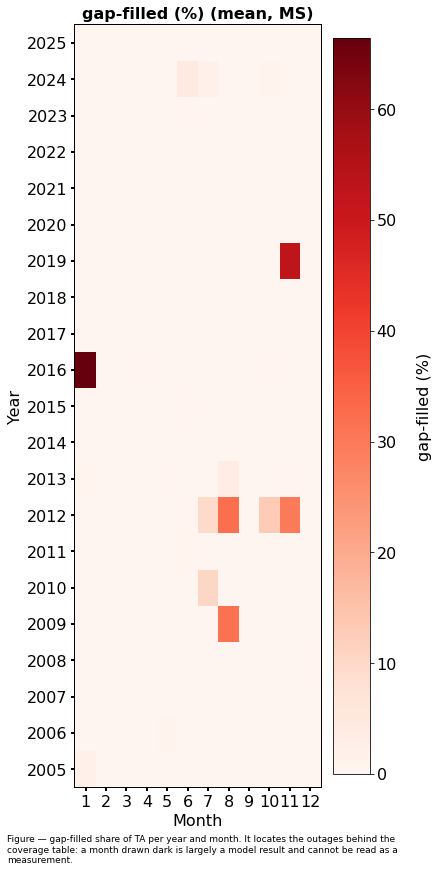
Summary statistics
Overall mean
# Mean of the yearly means, with the standard deviation between years. The mean over all records
# is printed next to it: the two differ slightly because years have different lengths.
_yearly_avg = series.resample('YE').mean()
_overall_mean = _yearly_avg.mean()
_overall_sd = _yearly_avg.std()
print(f"Overall mean (mean of yearly means): {_overall_mean:.2f} {units} "
      f"+/- {_overall_sd:.2f} {units} SD between years")
print(f"Mean over all records:               {series.mean():.2f} {units}")
print(f"Computed from {varname} (homogenised).")
Overall mean (mean of yearly means): 9.63 °C +/- 0.75 °C SD between years
Mean over all records: 9.63 °C
Computed from TA_T1_47_1_HOMOGENIZED_gfXG (homogenised).Yearly means
# One table for the year-by-year view: the mean and its anomaly against the record, the extremes
# the year reached, its rank, the two threshold-day counts detailed further below, and how much of
# it was gap-filled.
ym = per_year(series, 'mean')

yearly = pd.DataFrame({
    f"mean ({units})": ym,
    f"measured minimum ({units})": per_year(series_measured, 'min'),
    f"measured maximum ({units})": per_year(series_measured, 'max'),
    f"anomaly ({units})": ym - ym.mean(),
    "rank (warmest first)": ym.rank(ascending=False).astype(int),
    "frost days": per_year(daily['min'].lt(0).astype(float), 'sum'),
    "hot days": per_year(daily['max'].ge(30).astype(float), 'sum'),
    "gap-filled (%)": per_year(df[flagname].gt(0).astype(float), 'mean') * 100,
})

_fmt = {c: "{:.1f}" for c in yearly.columns}
_fmt.update({"rank (warmest first)": "{:.0f}", "frost days": "{:.0f}", "hot days": "{:.0f}"})
_styler = styled(yearly, caption=f"{var} per year: the mean and its anomaly against the record, the measured "
                         f"extremes of the year, its rank, the two threshold-day counts detailed "
                         f"further below, and the gap-filled share that says how far the row is a "
                         f"measurement", fmt=_fmt,
                 subset=[f"mean ({units})", f"measured minimum ({units})",
                         f"measured maximum ({units})"])
display(anomaly_bars(_styler, f"anomaly ({units})"))
Table — TA per year: the mean and its anomaly against the record, the measured extremes of the year,
its rank, the two threshold-day counts detailed further below, and the gap-filled share that says
how far the row is a measurement
| mean (°C) | measured minimum (°C) | measured maximum (°C) | anomaly (°C) | rank (warmest first) | frost days | hot days | gap-filled (%) | |
|---|---|---|---|---|---|---|---|---|
| YEAR | ||||||||
| 2005 | 8.7 | -13.1 | 32.1 | -0.9 | 19 | 105 | 5 | 0.2 |
| 2006 | 9.3 | -10.4 | 31.6 | -0.3 | 14 | 88 | 6 | 0.1 |
| 2007 | 9.4 | -8.4 | 31.2 | -0.2 | 13 | 58 | 2 | 0.1 |
| 2008 | 8.9 | -6.4 | 28.5 | -0.7 | 17 | 79 | 0 | 0.1 |
| 2009 | 9.3 | -15.1 | 31.0 | -0.4 | 15 | 83 | 3 | 2.8 |
| 2010 | 8.1 | -9.8 | 32.3 | -1.5 | 21 | 96 | 4 | 1.0 |
| 2011 | 10.1 | -8.4 | 32.0 | 0.5 | 6 | 53 | 4 | 0.1 |
| 2012 | 9.1 | -15.9 | 31.6 | -0.6 | 16 | 66 | 3 | 7.2 |
| 2013 | 8.4 | -8.2 | 33.1 | -1.2 | 20 | 100 | 5 | 0.5 |
| 2014 | 10.0 | -10.5 | 32.1 | 0.4 | 10 | 31 | 4 | 0.1 |
| 2015 | 10.1 | -7.0 | 34.0 | 0.4 | 8 | 70 | 13 | 0.1 |
| 2016 | 9.5 | -6.1 | 32.1 | -0.1 | 12 | 74 | 5 | 5.7 |
| 2017 | 9.6 | -12.2 | 30.2 | -0.0 | 11 | 83 | 2 | 0.0 |
| 2018 | 10.5 | -13.3 | 31.6 | 0.9 | 3 | 67 | 7 | 0.0 |
| 2019 | 10.0 | -6.6 | 32.9 | 0.4 | 9 | 63 | 7 | 4.3 |
| 2020 | 10.3 | -5.4 | 32.1 | 0.7 | 4 | 59 | 2 | 0.0 |
| 2021 | 8.9 | -12.1 | 29.0 | -0.7 | 18 | 84 | 0 | 0.0 |
| 2022 | 11.0 | -8.6 | 33.0 | 1.3 | 1 | 65 | 8 | 0.0 |
| 2023 | 10.6 | -8.4 | 32.7 | 1.0 | 2 | 60 | 8 | 0.1 |
| 2024 | 10.2 | -7.3 | 30.9 | 0.5 | 5 | 53 | 2 | 0.6 |
| 2025 | 10.1 | -6.9 | 31.0 | 0.4 | 7 | 65 | 3 | 0.0 |
Period means
# Means of the yearly means, on the same basis as the overall mean above. The record is split into
# the most recent N_RECENT_YEARS and everything before them, and the earlier period is the
# reference the recent one is compared against. The split follows the record, so it moves on as the
# dataset grows. Both boundary years are included.
_first_recent = ym.index.max() - N_RECENT_YEARS + 1
assert _first_recent > ym.index.min(), "not enough years before the recent period"
_early = (ym.index.min(), _first_recent - 1)
_recent = (_first_recent, ym.index.max())

_early_mean = ym.loc[_early[0]:_early[1]].mean()
_recent_mean = ym.loc[_recent[0]:_recent[1]].mean()
print(f"Average {var} {_early[0]}-{_early[1]}: {_early_mean:.1f} {units}")
print(f"Average {var} {_recent[0]}-{_recent[1]}: {_recent_mean:.1f} {units} "
      f"({_recent_mean - _early_mean:+.1f} {units} compared to {_early[0]}-{_early[1]})")

# The same difference on the measured column, to show how much of it is the sensor change.
_ym_meas = per_year(df[varname_measured], 'mean')
_early_meas = _ym_meas.loc[_early[0]:_early[1]].mean()
_recent_meas = _ym_meas.loc[_recent[0]:_recent[1]].mean()
print(f"\nOn the measured column the same difference is "
      f"{_recent_meas - _early_meas:+.1f} {units}. The gap between the two is the "
      f"instrument,\nnot the climate: see the homogenisation note at the top.")
Average TA 2005-2015: 9.2 °C
Average TA 2016-2025: 10.1 °C (+0.8 °C compared to 2005-2015)
On the measured column the same difference is +2.3 °C. The gap between the two is the instrument,
not the climate: see the homogenisation note at the top.Warmest and coolest years
# The full ranking is the `rank` column of the yearly table above; this lists the two ends of it.
for _label, _ranked in [(f"{N_RANKED} warmest years", ym.nlargest(N_RANKED)),
                        (f"{N_RANKED} coolest years", ym.nsmallest(N_RANKED))]:
    print(f"{_label}: " + ", ".join(f"{_year} ({_mean:.1f} {units})" for _year, _mean in _ranked.items()))
5 warmest years: 2022 (11.0 °C), 2023 (10.6 °C), 2018 (10.5 °C), 2020 (10.3 °C), 2024 (10.2 °C)
5 coolest years: 2010 (8.1 °C), 2013 (8.4 °C), 2005 (8.7 °C), 2021 (8.9 °C), 2008 (8.9 °C)Seasonality
Monthly means per year
# Monthly means, one row per year. The colour scale runs over the whole table, so a month can be
# compared against every other month as well as against the same month in other years.
monthly_avg = per_year_month(series, 'mean')
display(styled(monthly_avg, caption=f"monthly mean {var} ({units}), one row per year. The colour scale runs over the "
                            f"whole table, so the seasonal cycle dominates it and an unusual month "
                            f"shows against its own column", axis=None))
Table — monthly mean TA (°C), one row per year. The colour scale runs over the whole table, so the
seasonal cycle dominates it and an unusual month shows against its own column
| Jan | Feb | Mar | Apr | May | Jun | Jul | Aug | Sep | Oct | Nov | Dec | |
|---|---|---|---|---|---|---|---|---|---|---|---|---|
| YEAR | ||||||||||||
| 2005 | -0.5 | -2.0 | 4.9 | 8.6 | 13.2 | 18.0 | 17.9 | 15.8 | 15.1 | 11.2 | 3.5 | -1.6 |
| 2006 | -2.9 | -1.0 | 1.8 | 7.9 | 12.3 | 17.3 | 22.4 | 13.8 | 16.8 | 12.6 | 7.4 | 2.3 |
| 2007 | 3.2 | 4.3 | 5.2 | 14.1 | 13.7 | 16.3 | 16.7 | 16.6 | 12.5 | 8.8 | 2.1 | -0.5 |
| 2008 | 2.8 | 3.6 | 3.2 | 6.9 | 14.8 | 16.4 | 17.5 | 17.1 | 11.6 | 9.2 | 3.9 | -0.3 |
| 2009 | -2.7 | -0.3 | 3.2 | 11.3 | 14.8 | 15.5 | 17.9 | 19.6 | 15.3 | 9.1 | 6.7 | 0.2 |
| 2010 | -2.9 | -0.1 | 3.8 | 9.5 | 10.3 | 16.4 | 19.8 | 16.4 | 12.9 | 8.3 | 4.2 | -1.5 |
| 2011 | 0.4 | 2.4 | 6.1 | 12.7 | 15.0 | 16.0 | 15.8 | 19.0 | 16.3 | 9.1 | 5.6 | 2.6 |
| 2012 | 0.9 | -4.2 | 8.3 | 7.8 | 13.5 | 16.6 | 17.1 | 19.1 | 13.9 | 9.3 | 4.9 | 1.0 |
| 2013 | -0.5 | -2.3 | 1.7 | 7.8 | 9.5 | 15.3 | 20.5 | 18.3 | 14.1 | 10.8 | 2.9 | 2.3 |
| 2014 | 2.5 | 3.2 | 7.2 | 10.2 | 11.5 | 17.6 | 17.0 | 15.5 | 15.0 | 12.1 | 6.3 | 1.8 |
| 2015 | 0.9 | -0.8 | 5.9 | 9.6 | 12.9 | 17.2 | 21.6 | 20.0 | 12.5 | 8.2 | 6.8 | 5.0 |
| 2016 | 1.9 | 2.7 | 3.9 | 8.1 | 12.4 | 15.7 | 19.2 | 19.1 | 17.1 | 8.2 | 4.3 | 1.2 |
| 2017 | -3.8 | 3.5 | 8.0 | 8.1 | 14.2 | 19.0 | 18.7 | 19.4 | 12.6 | 11.3 | 3.7 | 0.1 |
| 2018 | 3.6 | -2.8 | 2.9 | 13.0 | 14.5 | 17.5 | 20.7 | 20.5 | 16.5 | 11.6 | 5.1 | 2.4 |
| 2019 | -1.1 | 4.2 | 6.3 | 8.7 | 9.9 | 19.3 | 20.2 | 18.8 | 14.7 | 11.1 | 4.7 | 3.2 |
| 2020 | 2.2 | 4.9 | 5.0 | 12.5 | 13.0 | 15.4 | 19.4 | 19.5 | 15.9 | 8.8 | 5.5 | 1.8 |
| 2021 | -0.6 | 4.0 | 4.9 | 7.1 | 9.4 | 18.2 | 17.2 | 16.3 | 16.1 | 9.5 | 2.8 | 1.5 |
| 2022 | 0.8 | 3.3 | 7.3 | 8.2 | 15.4 | 19.1 | 20.9 | 20.2 | 13.4 | 13.9 | 6.5 | 1.9 |
| 2023 | 1.5 | 3.0 | 5.9 | 6.7 | 12.9 | 19.5 | 19.3 | 19.3 | 18.4 | 13.0 | 4.3 | 3.0 |
| 2024 | 1.3 | 5.8 | 7.3 | 9.1 | 12.7 | 16.3 | 19.2 | 20.7 | 13.6 | 11.0 | 4.3 | 0.6 |
| 2025 | 1.6 | 1.9 | 7.2 | 10.9 | 13.0 | 19.9 | 17.6 | 19.1 | 13.9 | 8.7 | 4.8 | 1.6 |
Climatology per calendar month
# The same monthly means read the other way round: what each calendar month looks like across the
# record, and which year holds its extremes. The record low and high are half-hourly measured
# values, so they are colder and warmer than any monthly mean.
_records_low = series_measured.groupby(series_measured.index.month).min()
_records_high = series_measured.groupby(series_measured.index.month).max()

climatology = pd.DataFrame({
    f"mean ({units})": monthly_avg.mean(),
    f"SD between years ({units})": monthly_avg.std(),
    f"coolest year mean ({units})": monthly_avg.min(),
    "coolest year": monthly_avg.idxmin(),
    f"warmest year mean ({units})": monthly_avg.max(),
    "warmest year": monthly_avg.idxmax(),
    # Both frames run January to December, so the month numbers align with the month names.
    f"record low ({units})": _records_low.to_numpy(),
    f"record high ({units})": _records_high.to_numpy(),
})
climatology.index.name = "MONTH"

_fmt = {c: "{:.1f}" for c in climatology.columns}
_fmt.update({"coolest year": "{:.0f}", "warmest year": "{:.0f}"})
display(styled(climatology, caption=f"the same monthly means read per calendar month: the long-term mean, the spread "
                       f"between years, which year holds each month's extreme, and the measured "
                       f"record low and high of that month", fmt=_fmt,
               subset=[c for c in climatology.columns if c.endswith(f"({units})")]))
Table — the same monthly means read per calendar month: the long-term mean, the spread between
years, which year holds each month's extreme, and the measured record low and high of that month
| mean (°C) | SD between years (°C) | coolest year mean (°C) | coolest year | warmest year mean (°C) | warmest year | record low (°C) | record high (°C) | |
|---|---|---|---|---|---|---|---|---|
| MONTH | ||||||||
| Jan | 0.4 | 2.1 | -3.8 | 2017 | 3.6 | 2018 | -12.2 | 14.3 |
| Feb | 1.6 | 2.9 | -4.2 | 2012 | 5.8 | 2024 | -15.9 | 17.2 |
| Mar | 5.2 | 2.0 | 1.7 | 2013 | 8.3 | 2012 | -13.1 | 21.2 |
| Apr | 9.5 | 2.2 | 6.7 | 2023 | 14.1 | 2007 | -4.1 | 26.5 |
| May | 12.8 | 1.8 | 9.4 | 2021 | 15.4 | 2022 | -0.9 | 30.1 |
| Jun | 17.3 | 1.4 | 15.3 | 2013 | 19.9 | 2025 | 2.6 | 32.6 |
| Jul | 18.9 | 1.8 | 15.8 | 2011 | 22.4 | 2006 | 7.3 | 33.4 |
| Aug | 18.3 | 1.9 | 13.8 | 2006 | 20.7 | 2024 | 6.6 | 34.0 |
| Sep | 14.7 | 1.8 | 11.6 | 2008 | 18.4 | 2023 | 3.6 | 28.7 |
| Oct | 10.3 | 1.7 | 8.2 | 2016 | 13.9 | 2022 | -2.2 | 24.2 |
| Nov | 4.8 | 1.4 | 2.1 | 2007 | 7.4 | 2006 | -6.9 | 19.2 |
| Dec | 1.4 | 1.6 | -1.6 | 2005 | 5.0 | 2015 | -15.1 | 13.9 |
Mean annual cycle
# Mean annual cycle of the daily mean, with the spread across years behind it and the most recent
# year drawn on top. The bands are computed per day of year, so day 366 rests on the leap years
# only and is noisier than its neighbours.
_doy = daily['mean'].groupby(daily.index.dayofyear)
_x = _doy.mean().index

fig, ax = plt.subplots(figsize=(14, 6), dpi=72, layout="constrained")
ax.fill_between(_x, _doy.min(), _doy.max(), color='#ECEFF1',
                label=f"daily minimum to maximum {FIRST_YEAR}-{LAST_YEAR}")
ax.fill_between(_x, _doy.quantile(0.1), _doy.quantile(0.9), color='#B0BEC5',
                label="10th to 90th percentile")
ax.plot(_x, _doy.mean(), color='#37474F', lw=2, label="mean")
_last_year = daily['mean'].loc[str(LAST_YEAR)]
ax.plot(_last_year.index.dayofyear, _last_year.to_numpy(), color='#F44336', lw=1, label=str(LAST_YEAR))
ax.set_xlabel("Day of year")
ax.set_ylabel(xlabel)
ax.set_title(f"Mean annual cycle of daily mean {var} ({FIRST_YEAR}-{LAST_YEAR})")
ax.set_xlim(1, 366)
ax.grid(alpha=0.3)
ax.legend(loc='upper left', fontsize=9)
figcap(fig, f"mean annual cycle of daily mean {var}, with the spread across years behind it and the "
            f"most recent year drawn on top. The bands are computed per day of year, so day 366 rests "
            f"on the leap years alone and is noisier than its neighbours.")
fig.show()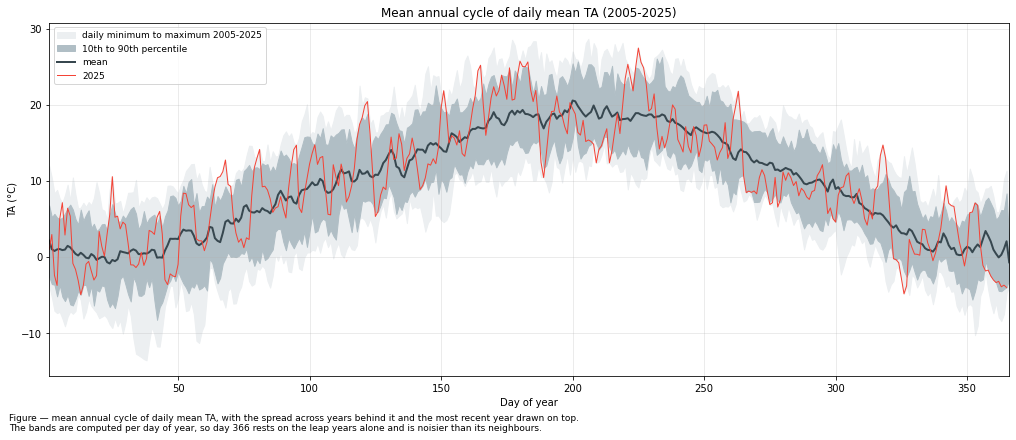
Recent period against the earlier years, per month
# The two periods of the period means, resolved by calendar month: which months carry the
# difference between them. A difference here is not a trend estimate, it is the distance between
# two averages; the trends are further below.
_split = monthly_avg.index.max() - N_RECENT_YEARS + 1
_early_label = f"{monthly_avg.index.min()}-{_split - 1} ({units})"
_recent_label = f"{_split}-{monthly_avg.index.max()} ({units})"
_difference_label = f"difference ({units})"

comparison = pd.DataFrame({
    _early_label: monthly_avg.loc[:_split - 1].mean(),
    _recent_label: monthly_avg.loc[_split:].mean(),
})
comparison[_difference_label] = comparison[_recent_label] - comparison[_early_label]
comparison.index.name = "MONTH"

_styler = styled(comparison, caption=f"the two periods of the period means resolved by calendar month, with the "
                        f"difference between them. It shows which part of the year carries that "
                        f"difference; it is a distance between two averages, not a trend estimate",
                 subset=[_early_label, _recent_label])
display(anomaly_bars(_styler, _difference_label))
Table — the two periods of the period means resolved by calendar month, with the difference between
them. It shows which part of the year carries that difference; it is a distance between two
averages, not a trend estimate
| 2005-2015 (°C) | 2016-2025 (°C) | difference (°C) | |
|---|---|---|---|
| MONTH | |||
| Jan | 0.1 | 0.7 | 0.6 |
| Feb | 0.3 | 3.1 | 2.8 |
| Mar | 4.7 | 5.9 | 1.2 |
| Apr | 9.7 | 9.2 | -0.4 |
| May | 12.9 | 12.7 | -0.2 |
| Jun | 16.6 | 18.0 | 1.4 |
| Jul | 18.6 | 19.2 | 0.7 |
| Aug | 17.4 | 19.3 | 1.9 |
| Sep | 14.2 | 15.2 | 1.0 |
| Oct | 9.9 | 10.7 | 0.8 |
| Nov | 4.9 | 4.6 | -0.3 |
| Dec | 1.0 | 1.7 | 0.7 |
Mean diurnal cycle per month
# Mean diurnal cycle per calendar month. The x axis is the centre of each 30MIN window, so the
# first point of the day is 00:15 and the last is 23:45.
_diurnal = series.groupby([series.index.month,
                           series.index.hour + series.index.minute / 60]).mean().unstack(0)

fig, ax = plt.subplots(figsize=(12, 7), dpi=72, layout="constrained")
_colors = plt.get_cmap('twilight_shifted')(np.linspace(0.05, 0.95, len(_diurnal.columns)))
for _i, _month in enumerate(_diurnal.columns):
    ax.plot(_diurnal.index, _diurnal[_month], color=_colors[_i], lw=2,
            label=calendar.month_abbr[_month])
ax.set_xlabel("Hour of day (local time, centre of the averaging window)")
ax.set_ylabel(xlabel)
ax.set_title(f"Mean diurnal cycle of {var} per month ({FIRST_YEAR}-{LAST_YEAR})")
ax.set_xticks(range(0, 25, 3))
ax.grid(alpha=0.3)
ax.legend(ncol=2, fontsize=9)
figcap(fig, f"mean diurnal cycle of {var} per calendar month. Both the level and the amplitude of the "
            f"daily course change through the year; the half-hourly heatmap further below shows the "
            f"same thing per date instead of per month.")
fig.show()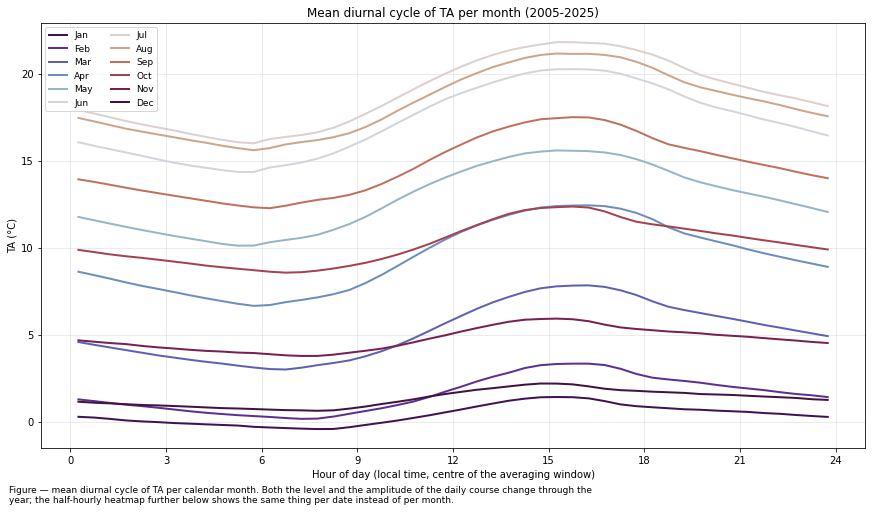
Month by hour
# The same cycle as a surface, next to the departure of the most recent year from it. The right
# panel is centred on zero, so red and blue are equal distances from the long-term mean.
def _by_month_hour(s):
    """Mean of `s` per calendar month and hour, in the long form HeatmapXYZ expects."""
    frame = pd.DataFrame({'MONTH': s.index.month, 'HOUR': s.index.hour, 'z': s.to_numpy()})
    return frame.groupby(['MONTH', 'HOUR'], as_index=False)['z'].mean()


_clim_hm = _by_month_hour(series)
_last_hm = _by_month_hour(series.loc[str(LAST_YEAR)])
_anomaly_hm = _clim_hm.copy()
_anomaly_hm['z'] = _last_hm['z'].to_numpy() - _clim_hm['z'].to_numpy()
_absmax = _anomaly_hm['z'].abs().max()

fig, axs = plt.subplots(ncols=2, figsize=(17, 6), dpi=72, layout="constrained")
dv.plotting.HeatmapXYZ(x=_clim_hm['MONTH'], y=_clim_hm['HOUR'], z=_clim_hm['z']).plot(
    ax=axs[0], cb_digits_after_comma=0,
    xlabel="Month", ylabel="Hour of day", zlabel=f"{var} ({units})",
    format_style=dv.plotting.FormatStyle(title=f"Mean {var} by month and hour"))
dv.plotting.HeatmapXYZ(x=_anomaly_hm['MONTH'], y=_anomaly_hm['HOUR'], z=_anomaly_hm['z']).plot(
    ax=axs[1], cmap='RdBu_r', vmin=-_absmax, vmax=_absmax, cb_digits_after_comma=1,
    xlabel="Month", ylabel="Hour of day", zlabel=f"{LAST_YEAR} minus mean ({units})",
    format_style=dv.plotting.FormatStyle(title=f"{LAST_YEAR} departure from the mean"))
figcap(fig, f"left: mean {var} by calendar month and hour of day, the seasonal and the diurnal cycle "
            f"on one surface. Right: the departure of {LAST_YEAR} from that mean, centred on zero, so "
            f"it can be read for the time of day at which the year differed.")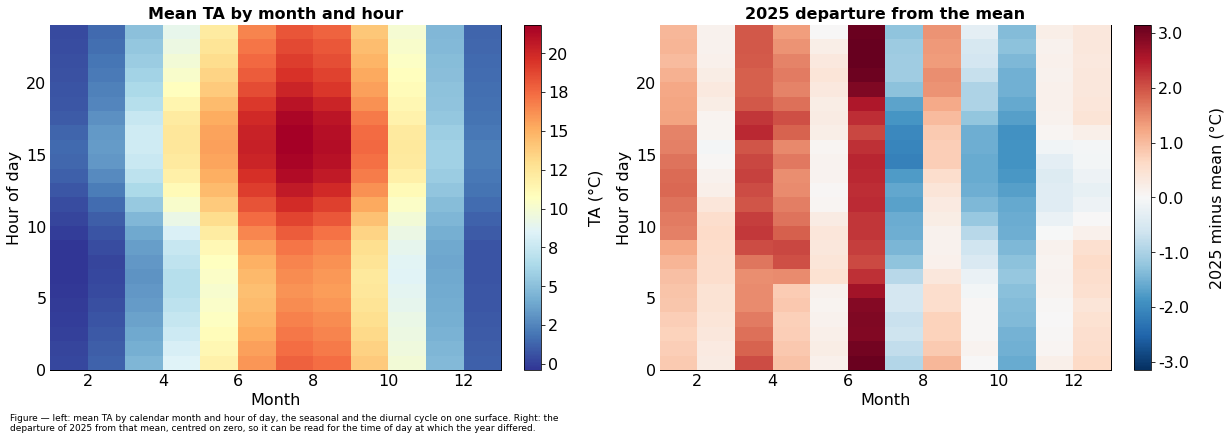
Extremes and threshold days
NoteRead the daily-shape steps before comparing across January 2016
The homogenisation corrects the level of the earlier era and most of the difference between the two radiation shields, which is what acts in daylight. The residual step left in each daily statistic is measured in What the correction does to the shape of the day below, and is small next to the step the measured column carries.
It is not zero, though, and everything in this section built on a daily maximum — summer days, hot days, warm spells, new record highs — is the most exposed to what remains. On the measured column these counts are not comparable across 2016 at all. Frost days, ice days and the growing season rest on daily minima and daily means, which the correction leaves almost free of a step.
Highest and lowest half-hourly value
# Extremes come from the measured records only (see About). The averaging window is reported
# instead of the timestamp, because the product is stored on TIMESTAMP_MIDDLE.
for _label, _tsmid in [("Highest", series_measured.idxmax()), ("Lowest", series_measured.idxmin())]:
    print(f"{_label} measured {var}: {series_measured.loc[_tsmid]:.1f} {units} ({window(_tsmid)})")

# A gap-filled value outside the measured range would be quoted as a record by anyone reading the
# full series, so the two ranges are compared rather than left to be discovered.
if (series.max() > series_measured.max()) or (series.min() < series_measured.min()):
    print(f"Note: the full series reaches {series.min():.1f} to {series.max():.1f} {units}, "
          f"outside the measured range. Those values are model results.")
else:
    print("The gap-filled values stay inside the measured range.")
Highest measured TA: 34.0 °C (07 Aug 2015, 17:00 to 17:30)
Lowest measured TA: -15.9 °C (07 Feb 2012, 04:30 to 05:00)
The gap-filled values stay inside the measured range.The warmest and coldest half-hours
# The extremes above in context. Neighbouring half-hours of the same afternoon fill these lists,
# which is the point: a record half-hour is part of an episode, not an isolated reading.
for _label, _ranked in [("warmest", series_measured.nlargest(N_EXTREMES)),
                        ("coldest", series_measured.nsmallest(N_EXTREMES))]:
    _table = pd.DataFrame({"averaging window": [window(_ts) for _ts in _ranked.index],
                           f"{var} ({units})": _ranked.to_numpy()},
                          index=range(1, N_EXTREMES + 1))
    _table.index.name = "rank"
    display(styled(_table, caption=f"the {N_EXTREMES} {_label} measured half-hours with their averaging "
                           f"windows. Neighbouring windows of a single afternoon fill the list, "
                           f"which is what an episode looks like at this resolution",
                   subset=[f"{var} ({units})"]))
Table — the 10 warmest measured half-hours with their averaging windows. Neighbouring windows of a
single afternoon fill the list, which is what an episode looks like at this resolution
| averaging window | TA (°C) | |
|---|---|---|
| rank | ||
| 1 | 07 Aug 2015, 17:00 to 17:30 | 34.0 |
| 2 | 07 Aug 2015, 16:30 to 17:00 | 33.9 |
| 3 | 07 Aug 2015, 16:00 to 16:30 | 33.7 |
| 4 | 07 Aug 2015, 17:30 to 18:00 | 33.5 |
| 5 | 07 Jul 2015, 15:30 to 16:00 | 33.4 |
| 6 | 07 Jul 2015, 16:00 to 16:30 | 33.4 |
| 7 | 07 Aug 2015, 18:00 to 18:30 | 33.3 |
| 8 | 07 Jul 2015, 15:00 to 15:30 | 33.3 |
| 9 | 07 Jul 2015, 16:30 to 17:00 | 33.2 |
| 10 | 07 Aug 2015, 15:30 to 16:00 | 33.2 |
Table — the 10 coldest measured half-hours with their averaging windows. Neighbouring windows of a
single afternoon fill the list, which is what an episode looks like at this resolution
| averaging window | TA (°C) | |
|---|---|---|
| rank | ||
| 1 | 07 Feb 2012, 04:30 to 05:00 | -15.9 |
| 2 | 06 Feb 2012, 07:30 to 08:00 | -15.8 |
| 3 | 07 Feb 2012, 04:00 to 04:30 | -15.8 |
| 4 | 06 Feb 2012, 07:00 to 07:30 | -15.8 |
| 5 | 06 Feb 2012, 08:00 to 08:30 | -15.8 |
| 6 | 07 Feb 2012, 05:00 to 05:30 | -15.7 |
| 7 | 07 Feb 2012, 02:00 to 02:30 | -15.7 |
| 8 | 06 Feb 2012, 06:30 to 07:00 | -15.6 |
| 9 | 05 Feb 2012, 07:30 to 08:00 | -15.6 |
| 10 | 07 Feb 2012, 01:30 to 02:00 | -15.6 |
The warmest and coldest days
# The same for daily means. A daily mean is computed over all records of the day, gap-filled ones
# included, so the filled share is listed next to it.
for _label, _ranked in [("warmest", daily['mean'].nlargest(N_EXTREMES)),
                        ("coldest", daily['mean'].nsmallest(N_EXTREMES))]:
    _table = pd.DataFrame({"date": [f"{_day:%d %b %Y}" for _day in _ranked.index],
                           f"daily mean {var} ({units})": _ranked.to_numpy(),
                           "gap-filled (%)": daily.loc[_ranked.index, 'gap-filled (%)'].to_numpy()},
                          index=range(1, N_EXTREMES + 1))
    _table.index.name = "rank"
    display(styled(_table, caption=f"the {N_EXTREMES} {_label} days by daily mean, with the share of each day "
                           f"that was gap-filled. A day with a large filled share is a model "
                           f"result as much as a measurement",
                   subset=[f"daily mean {var} ({units})"]))
Table — the 10 warmest days by daily mean, with the share of each day that was gap-filled. A day
with a large filled share is a model result as much as a measurement
| date | daily mean TA (°C) | gap-filled (%) | |
|---|---|---|---|
| rank | |||
| 1 | 25 Jul 2019 | 28.7 | 0.0 |
| 2 | 26 Jun 2019 | 28.6 | 0.0 |
| 3 | 05 Jul 2015 | 28.4 | 0.0 |
| 4 | 04 Jul 2015 | 28.4 | 0.0 |
| 5 | 07 Aug 2015 | 28.2 | 0.0 |
| 6 | 27 Jul 2013 | 28.2 | 0.0 |
| 7 | 24 Jul 2019 | 28.1 | 0.0 |
| 8 | 04 Aug 2022 | 28.0 | 0.0 |
| 9 | 27 Jun 2019 | 27.9 | 0.0 |
| 10 | 03 Jul 2015 | 27.8 | 0.0 |
Table — the 10 coldest days by daily mean, with the share of each day that was gap-filled. A day
with a large filled share is a model result as much as a measurement
| date | daily mean TA (°C) | gap-filled (%) | |
|---|---|---|---|
| rank | |||
| 1 | 07 Feb 2012 | -13.6 | 0.0 |
| 2 | 06 Feb 2012 | -13.4 | 0.0 |
| 3 | 05 Feb 2012 | -13.2 | 0.0 |
| 4 | 04 Feb 2012 | -12.9 | 0.0 |
| 5 | 03 Feb 2012 | -12.7 | 2.1 |
| 6 | 12 Feb 2012 | -11.8 | 0.0 |
| 7 | 11 Feb 2012 | -11.7 | 0.0 |
| 8 | 27 Feb 2018 | -11.3 | 0.0 |
| 9 | 08 Feb 2012 | -11.1 | 0.0 |
| 10 | 26 Feb 2018 | -11.0 | 0.0 |
Number of days below 0°C
plotdf = df[[varname]].copy()
plotdf = plotdf.resample('D').min()
belowzero = plotdf.loc[plotdf[varname] < 0].copy()
belowzero = belowzero.groupby(belowzero.index.year).count()
belowzero["YEAR"] = belowzero.index
_ax = belowzero.plot.bar(x="YEAR", y=varname, title=f"Number of days with {varname} < 0°")
figcap(_ax.get_figure(), f"days per year with a daily minimum {var} below 0 {units}. Years without "
                         f"such a day carry no bar rather than a zero.")

_table = belowzero[[varname]].rename(columns={varname: "days"})
_table.index.name = "YEAR"
display(styled(_table, caption=f"days per year with a daily minimum {var} below 0 {units}, the counts behind "
                       f"the bar chart in this section",
               fmt="{:.0f}", cmap="Blues"))
print(f"Average per year: {belowzero[varname].mean():.1f} +/- {belowzero[varname].std():.2f} SD")
Table — days per year with a daily minimum TA below 0 °C, the counts behind the bar chart in this
section
| days | |
|---|---|
| YEAR | |
| 2005 | 105 |
| 2006 | 88 |
| 2007 | 58 |
| 2008 | 79 |
| 2009 | 83 |
| 2010 | 96 |
| 2011 | 53 |
| 2012 | 66 |
| 2013 | 100 |
| 2014 | 31 |
| 2015 | 70 |
| 2016 | 74 |
| 2017 | 83 |
| 2018 | 67 |
| 2019 | 63 |
| 2020 | 59 |
| 2021 | 84 |
| 2022 | 65 |
| 2023 | 60 |
| 2024 | 53 |
| 2025 | 65 |
Average per year: 71.5 +/- 17.74 SD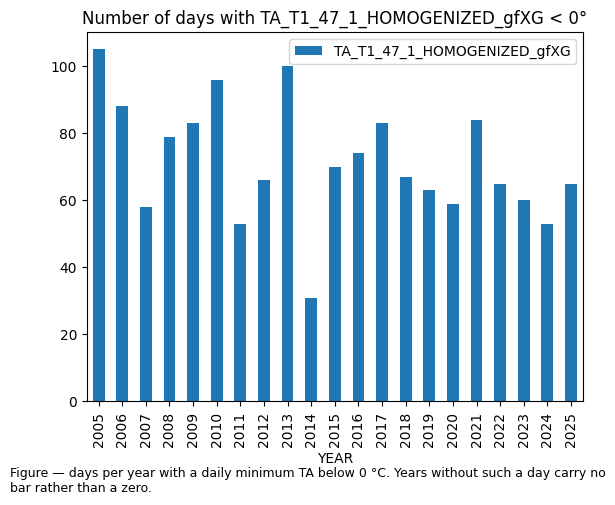
Number of days above 30°C
plotdf = df[[varname]].copy()
plotdf = plotdf.resample('D').max()
above = plotdf.loc[plotdf[varname] > 30].copy()
above = above.groupby(above.index.year).count()
above["YEAR"] = above.index
_ax = above.plot.bar(x="YEAR", y=varname, title=f"Number of days with {varname} > 30°")
figcap(_ax.get_figure(), f"days per year with a daily maximum {var} above 30 {units}. Years without "
                         f"such a day carry no bar rather than a zero.")

_table = above[[varname]].rename(columns={varname: "days"})
_table.index.name = "YEAR"
display(styled(_table, caption=f"days per year with a daily maximum {var} above 30 {units}, the counts behind "
                       f"the bar chart in this section",
               fmt="{:.0f}", cmap="Reds"))
print(f"Average per year: {above[varname].mean():.1f} +/- {above[varname].std():.2f} SD")
Table — days per year with a daily maximum TA above 30 °C, the counts behind the bar chart in this
section
| days | |
|---|---|
| YEAR | |
| 2005 | 5 |
| 2006 | 6 |
| 2007 | 2 |
| 2009 | 3 |
| 2010 | 4 |
| 2011 | 4 |
| 2012 | 3 |
| 2013 | 5 |
| 2014 | 4 |
| 2015 | 13 |
| 2016 | 5 |
| 2017 | 2 |
| 2018 | 7 |
| 2019 | 7 |
| 2020 | 2 |
| 2022 | 8 |
| 2023 | 8 |
| 2024 | 2 |
| 2025 | 3 |
Average per year: 4.9 +/- 2.81 SD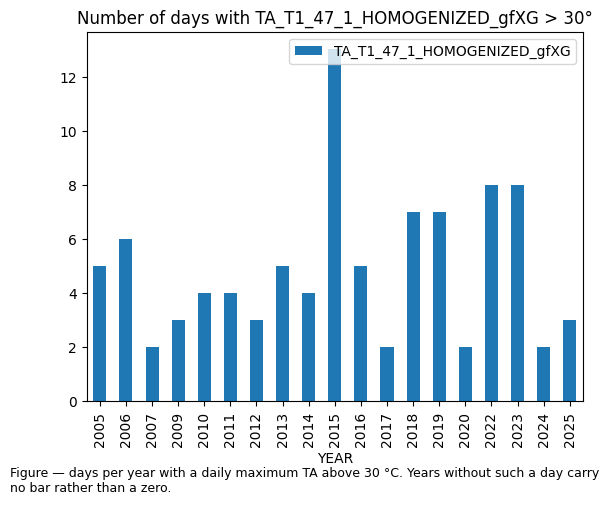
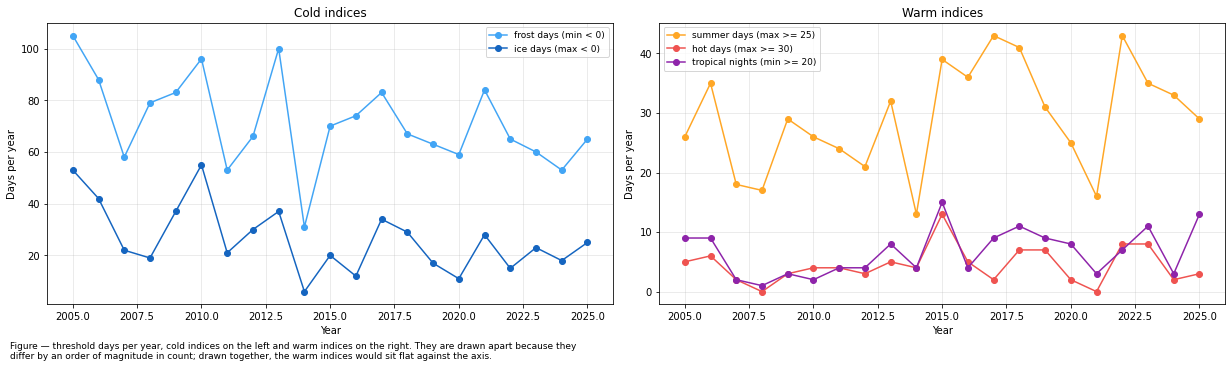
Threshold days
# The standard threshold-day counts. The two sections above are two of these; the set is listed
# together so that a year can be read in one row. Thresholds are the usual ones and are stated in
# the column names, because the counts mean nothing without them.
indices = pd.DataFrame({
    "frost days (min < 0)": per_year(daily['min'].lt(0).astype(float), 'sum'),
    "ice days (max < 0)": per_year(daily['max'].lt(0).astype(float), 'sum'),
    "summer days (max >= 25)": per_year(daily['max'].ge(25).astype(float), 'sum'),
    "hot days (max >= 30)": per_year(daily['max'].ge(30).astype(float), 'sum'),
    "tropical nights (min >= 20)": per_year(daily['min'].ge(20).astype(float), 'sum'),
})
display(styled(indices, caption="threshold days per year for the five standard indices, each with its threshold in the column name. The counts come from daily minima and maxima of the full series, gap-filled records included", fmt="{:.0f}", cmap="RdYlBu_r"))

# Cold and warm indices are drawn apart because they differ by an order of magnitude in count.
fig, axs = plt.subplots(ncols=2, figsize=(17, 5), dpi=72, layout="constrained")
indices[["frost days (min < 0)", "ice days (max < 0)"]].plot(ax=axs[0], marker='o', lw=1.5,
                                                             color=['#42A5F5', '#1565C0'])
indices[["summer days (max >= 25)", "hot days (max >= 30)",
         "tropical nights (min >= 20)"]].plot(ax=axs[1], marker='o', lw=1.5,
                                              color=['#FFA726', '#EF5350', '#8E24AA'])
for _ax, _title in [(axs[0], "Cold indices"), (axs[1], "Warm indices")]:
    _ax.set_title(_title)
    _ax.set_xlabel("Year")
    _ax.set_ylabel("Days per year")
    _ax.grid(alpha=0.3)
    _ax.legend(fontsize=9)
figcap(fig, "threshold days per year, cold indices on the left and warm indices on the right. They "
            "are drawn apart because they differ by an order of magnitude in count; drawn together, "
            "the warm indices would sit flat against the axis.")
Table — threshold days per year for the five standard indices, each with its threshold in the column
name. The counts come from daily minima and maxima of the full series, gap-filled records included
| frost days (min < 0) | ice days (max < 0) | summer days (max >= 25) | hot days (max >= 30) | tropical nights (min >= 20) | |
|---|---|---|---|---|---|
| YEAR | |||||
| 2005 | 105 | 53 | 26 | 5 | 9 |
| 2006 | 88 | 42 | 35 | 6 | 9 |
| 2007 | 58 | 22 | 18 | 2 | 2 |
| 2008 | 79 | 19 | 17 | 0 | 1 |
| 2009 | 83 | 37 | 29 | 3 | 3 |
| 2010 | 96 | 55 | 26 | 4 | 2 |
| 2011 | 53 | 21 | 24 | 4 | 4 |
| 2012 | 66 | 30 | 21 | 3 | 4 |
| 2013 | 100 | 37 | 32 | 5 | 8 |
| 2014 | 31 | 6 | 13 | 4 | 4 |
| 2015 | 70 | 20 | 39 | 13 | 15 |
| 2016 | 74 | 12 | 36 | 5 | 4 |
| 2017 | 83 | 34 | 43 | 2 | 9 |
| 2018 | 67 | 29 | 41 | 7 | 11 |
| 2019 | 63 | 17 | 31 | 7 | 9 |
| 2020 | 59 | 11 | 25 | 2 | 8 |
| 2021 | 84 | 28 | 16 | 0 | 3 |
| 2022 | 65 | 15 | 43 | 8 | 7 |
| 2023 | 60 | 23 | 35 | 8 | 11 |
| 2024 | 53 | 18 | 33 | 2 | 3 |
| 2025 | 65 | 25 | 29 | 3 | 13 |
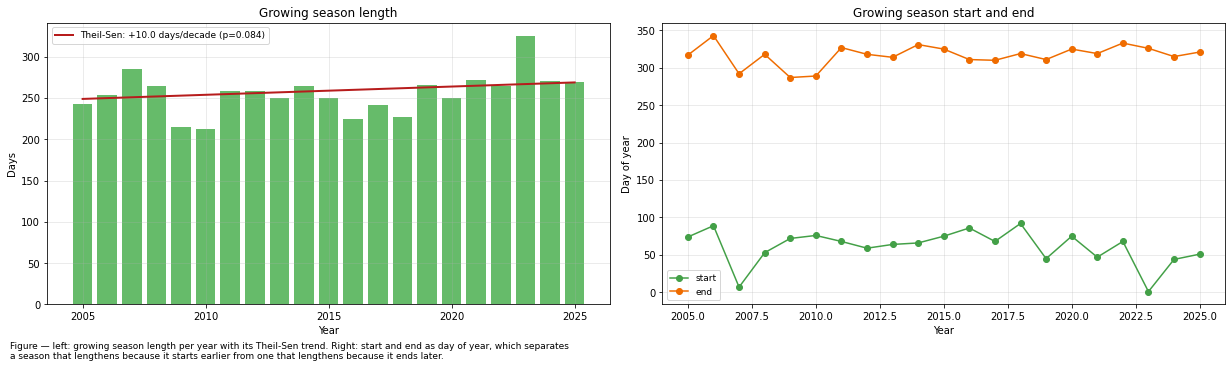
Growing season
# Growing season and growing degree days per year, both on a 5 °C base. See `growing_season` for
# the definition; it is one convention among several and the numbers are only comparable to
# numbers computed the same way.
BASE = 5.0

_rows = {}
for _year, _daily_mean in daily['mean'].groupby(daily.index.year):
    _season = growing_season(_daily_mean, base=BASE)
    if _season is None:
        continue
    _rows[_year] = {"start": f"{_season['start']:%d %b}",
                    "end": f"{_season['end']:%d %b}",
                    "length (days)": _season['length'],
                    "start (day of year)": _season['start'].dayofyear,
                    "end (day of year)": _season['end'].dayofyear}
season = pd.DataFrame.from_dict(_rows, orient='index')
season.index.name = "YEAR"
season["growing degree days (°C d)"] = per_year((daily['mean'] - BASE).clip(lower=0), 'sum')

_fmt = "{:.0f}"
display(styled(season, caption=f"growing season per year on a {BASE:.0f} {units} base: start, end, length and "
                       f"growing degree days. The definition is the one in `growing_season` and "
                       f"the numbers only compare against numbers computed the same way", fmt=_fmt,
               subset=["length (days)", "growing degree days (°C d)"], cmap="YlGn"))

fig, axs = plt.subplots(ncols=2, figsize=(17, 5), dpi=72, layout="constrained")
axs[0].bar(season.index, season["length (days)"], color='#66BB6A')
_fit = trend(season["length (days)"].astype(float))
axs[0].plot(_fit['fit'].index, _fit['fit'], color='#B71C1C', lw=2,
            label=f"Theil-Sen: {_fit['slope']:+.1f} days/decade (p={_fit['pvalue']:.3f})")
axs[0].set_title("Growing season length")
axs[0].set_ylabel("Days")
axs[0].legend(fontsize=9)
axs[1].plot(season.index, season["start (day of year)"], marker='o', color='#43A047',
            label="start")
axs[1].plot(season.index, season["end (day of year)"], marker='o', color='#EF6C00', label="end")
axs[1].set_title("Growing season start and end")
axs[1].set_ylabel("Day of year")
axs[1].legend(fontsize=9)
for _ax in axs:
    _ax.set_xlabel("Year")
    _ax.grid(alpha=0.3)
figcap(fig, "left: growing season length per year with its Theil-Sen trend. Right: start and end as "
            "day of year, which separates a season that lengthens because it starts earlier from one "
            "that lengthens because it ends later.")
Table — growing season per year on a 5 °C base: start, end, length and growing degree days. The
definition is the one in `growing_season` and the numbers only compare against numbers computed the
same way
| start | end | length (days) | start (day of year) | end (day of year) | growing degree days (°C d) | |
|---|---|---|---|---|---|---|
| YEAR | ||||||
| 2005 | 15 Mar | 13 Nov | 243 | 74 | 317 | 2142 |
| 2006 | 30 Mar | 09 Dec | 254 | 89 | 343 | 2240 |
| 2007 | 07 Jan | 19 Oct | 285 | 7 | 292 | 2074 |
| 2008 | 22 Feb | 13 Nov | 265 | 53 | 318 | 1920 |
| 2009 | 13 Mar | 14 Oct | 215 | 72 | 287 | 2196 |
| 2010 | 17 Mar | 16 Oct | 213 | 76 | 289 | 1943 |
| 2011 | 09 Mar | 23 Nov | 259 | 68 | 327 | 2274 |
| 2012 | 28 Feb | 13 Nov | 259 | 59 | 318 | 2118 |
| 2013 | 05 Mar | 10 Nov | 250 | 64 | 314 | 1979 |
| 2014 | 07 Mar | 27 Nov | 265 | 66 | 331 | 2133 |
| 2015 | 16 Mar | 21 Nov | 250 | 75 | 325 | 2267 |
| 2016 | 26 Mar | 06 Nov | 225 | 86 | 311 | 2095 |
| 2017 | 09 Mar | 06 Nov | 242 | 68 | 310 | 2283 |
| 2018 | 02 Apr | 15 Nov | 227 | 92 | 319 | 2536 |
| 2019 | 14 Feb | 07 Nov | 266 | 45 | 311 | 2253 |
| 2020 | 15 Mar | 20 Nov | 250 | 75 | 325 | 2307 |
| 2021 | 16 Feb | 15 Nov | 272 | 47 | 319 | 1971 |
| 2022 | 09 Mar | 29 Nov | 265 | 68 | 333 | 2561 |
| 2023 | 01 Jan | 22 Nov | 325 | 1 | 326 | 2432 |
| 2024 | 13 Feb | 10 Nov | 271 | 44 | 315 | 2270 |
| 2025 | 20 Feb | 17 Nov | 270 | 51 | 321 | 2275 |
Warm and cold spells
# The longest warm and cold spells of each year: how long a threshold was held without a break,
# and when the spell started. A year can reach a high count of summer days without ever holding
# one for a week, and the two say different things about the season.
_rows = {}
for _year, _day in daily.groupby(daily.index.year):
    _warm_len, _warm_start = longest_spell(_day['max'].ge(25))
    _frost_len, _frost_start = longest_spell(_day['min'].lt(0))
    _rows[_year] = {"warm spell (days)": _warm_len,
                    "warm spell start": "-" if pd.isna(_warm_start) else f"{_warm_start:%d %b}",
                    "frost spell (days)": _frost_len,
                    "frost spell start": "-" if pd.isna(_frost_start) else f"{_frost_start:%d %b}"}
spells = pd.DataFrame.from_dict(_rows, orient='index')
spells.index.name = "YEAR"

display(styled(spells, caption="the longest uninterrupted warm and frost spell of each year with its start "
                               "date. A year can collect many summer days without ever holding "
                               "one for a week, which the counts above cannot show",
               fmt="{:.0f}", cmap="RdYlBu_r"))
Table — the longest uninterrupted warm and frost spell of each year with its start date. A year can
collect many summer days without ever holding one for a week, which the counts above cannot show
| warm spell (days) | warm spell start | frost spell (days) | frost spell start | |
|---|---|---|---|---|
| YEAR | ||||
| 2005 | 6 | 19 Jun | 30 | 13 Feb |
| 2006 | 19 | 10 Jul | 24 | 22 Jan |
| 2007 | 4 | 13 Jul | 17 | 13 Dec |
| 2008 | 5 | 21 Jun | 13 | 21 Nov |
| 2009 | 7 | 15 Aug | 18 | 01 Jan |
| 2010 | 8 | 26 Jun | 16 | 01 Jan |
| 2011 | 10 | 17 Aug | 17 | 19 Jan |
| 2012 | 5 | 18 Aug | 27 | 28 Jan |
| 2013 | 13 | 16 Jul | 31 | 02 Feb |
| 2014 | 6 | 07 Jun | 6 | 26 Dec |
| 2015 | 9 | 29 Jun | 28 | 17 Jan |
| 2016 | 7 | 08 Sep | 12 | 13 Jan |
| 2017 | 8 | 29 Jul | 16 | 13 Jan |
| 2018 | 17 | 24 Jul | 15 | 01 Feb |
| 2019 | 8 | 24 Jun | 15 | 02 Jan |
| 2020 | 6 | 27 Jul | 18 | 24 Nov |
| 2021 | 6 | 15 Jun | 19 | 01 Jan |
| 2022 | 13 | 13 Jul | 17 | 03 Dec |
| 2023 | 7 | 18 Aug | 17 | 16 Jan |
| 2024 | 8 | 09 Aug | 16 | 07 Jan |
| 2025 | 9 | 08 Aug | 14 | 09 Jan |
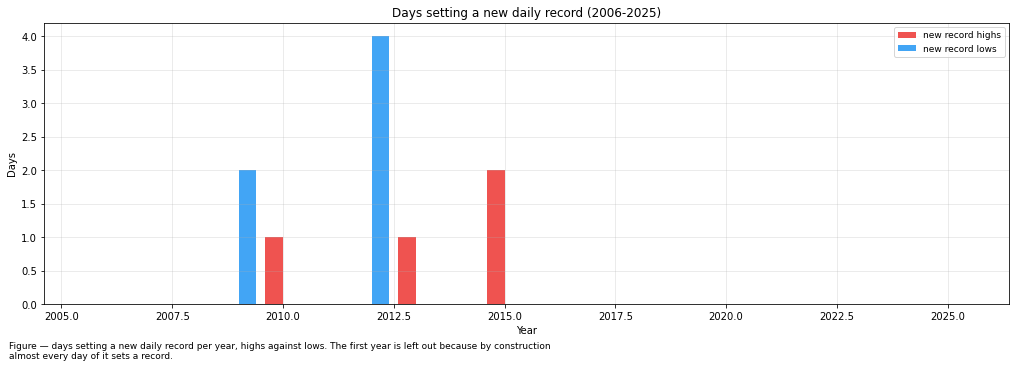
New records per year
Read forwards: a record is a record against what came before it, not against the whole dataset. Record highs are the statistic most exposed to whatever daytime inhomogeneity remains, so some part of their concentration in the later years may still be the change of sensor. Record lows rest on daily minima and are much less affected.
# Days that set a new record for the record so far, counted per year. The first year is left out:
# by construction almost every day of it sets a record, which would swamp the plot. Reading this
# forwards only is the point - a record is a record against what came before it, not against the
# whole dataset.
_running_high = daily_measured['max'].shift().cummax()
_running_low = daily_measured['min'].shift().cummin()
_new_high = daily_measured['max'] > _running_high
_new_low = daily_measured['min'] < _running_low

records = pd.DataFrame({
    "new record highs": per_year(_new_high.astype(float), 'sum'),
    "new record lows": per_year(_new_low.astype(float), 'sum'),
}).loc[FIRST_YEAR + 1:]

display(styled(records, caption=f"days that set a new record against everything measured before them, counted "
                       f"per year from {FIRST_YEAR + 1}. Records necessarily thin out as the "
                       f"record grows, so a late year holding several is the notable case",
               fmt="{:.0f}", cmap="RdYlBu_r"))

fig, ax = plt.subplots(figsize=(14, 5), dpi=72, layout="constrained")
ax.bar(records.index - 0.2, records["new record highs"], width=0.4, color='#EF5350',
       label="new record highs")
ax.bar(records.index + 0.2, records["new record lows"], width=0.4, color='#42A5F5',
       label="new record lows")
ax.set_xlabel("Year")
ax.set_ylabel("Days")
ax.set_title(f"Days setting a new daily record ({FIRST_YEAR + 1}-{LAST_YEAR})")
ax.grid(alpha=0.3)
ax.legend(fontsize=9)
figcap(fig, f"days setting a new daily record per year, highs against lows. The first year is left "
            f"out because by construction almost every day of it sets a record.")
fig.show()
Table — days that set a new record against everything measured before them, counted per year from
2006. Records necessarily thin out as the record grows, so a late year holding several is the
notable case
| new record highs | new record lows | |
|---|---|---|
| YEAR | ||
| 2006 | 0 | 0 |
| 2007 | 0 | 0 |
| 2008 | 0 | 0 |
| 2009 | 0 | 2 |
| 2010 | 1 | 0 |
| 2011 | 0 | 0 |
| 2012 | 0 | 4 |
| 2013 | 1 | 0 |
| 2014 | 0 | 0 |
| 2015 | 2 | 0 |
| 2016 | 0 | 0 |
| 2017 | 0 | 0 |
| 2018 | 0 | 0 |
| 2019 | 0 | 0 |
| 2020 | 0 | 0 |
| 2021 | 0 | 0 |
| 2022 | 0 | 0 |
| 2023 | 0 | 0 |
| 2024 | 0 | 0 |
| 2025 | 0 | 0 |
Distributions
Ridgeline plots of the half-hourly values, then the same distributions read as percentiles.
Ridgelines per year
rp = dv.plotting.RidgeLinePlot(series=series)
rp.plot(
    how='yearly',
    kd_kwargs=None,  # params from scikit KernelDensity as dict
    xlim=xlim,  # min/max as list
    ylim=[0, 0.07],  # min/max as list
    hspace=-0.8,  # overlap between months
    fig_width=5,
    fig_height=9,
    shade_percentile=0.5,
    show_mean_line=False,
    format_style=dv.plotting.FormatStyle(xlabel=xlabel, title=f"{var} per year"),
    fig_dpi=72,
    showplot=True,
    ascending=False
)
figcap(rp.fig, f"distribution of half-hourly {var} per year, most recent year at the top. The shaded "
               f"part of each ridge is its upper half, so a year that shifted as a whole can be told "
               f"from one that only stretched at one end.")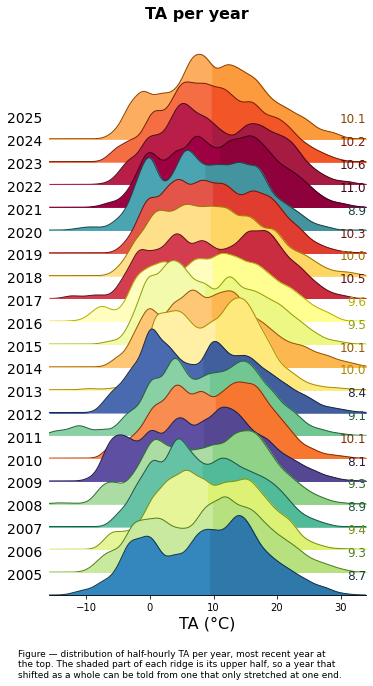
Ridgelines per month
rp.plot(
    how='monthly',
    kd_kwargs=None,  # params from scikit KernelDensity as dict
    xlim=xlim,  # min/max as list
    ylim=[0, 0.14],  # min/max as list
    hspace=-0.6,  # overlap between months
    fig_width=4.5,
    fig_height=8,
    shade_percentile=0.5,
    show_mean_line=False,
    format_style=dv.plotting.FormatStyle(xlabel=xlabel,
                                         title=f"{var} per month ({FIRST_YEAR}-{LAST_YEAR})"),
    fig_dpi=72,
    showplot=True,
    ascending=False
)
figcap(rp.fig, f"the same distributions per calendar month, all years pooled: the seasonal cycle as a "
               f"sequence of distributions rather than of means.")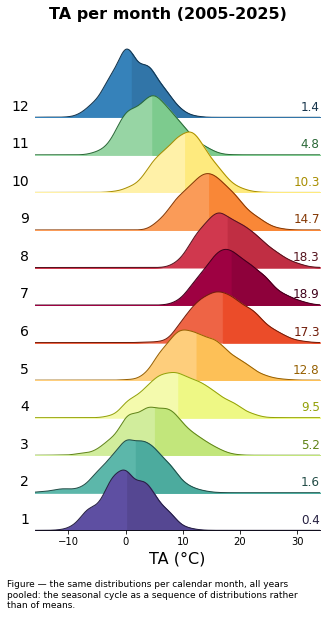
Ridgelines per week
rp.plot(
    how='weekly',
    kd_kwargs=None,  # params from scikit KernelDensity as dict
    xlim=xlim,  # min/max as list
    ylim=[0, 0.15],  # min/max as list
    hspace=-0.6,  # overlap
    fig_width=6,
    fig_height=16,
    shade_percentile=0.5,
    show_mean_line=False,
    format_style=dv.plotting.FormatStyle(xlabel=xlabel,
                                         title=f"{var} per week ({FIRST_YEAR}-{LAST_YEAR})"),
    fig_dpi=72,
    showplot=True,
    ascending=False
)
figcap(rp.fig, f"the same per week of the year, which resolves the shoulder seasons that the monthly "
               f"version smooths over.")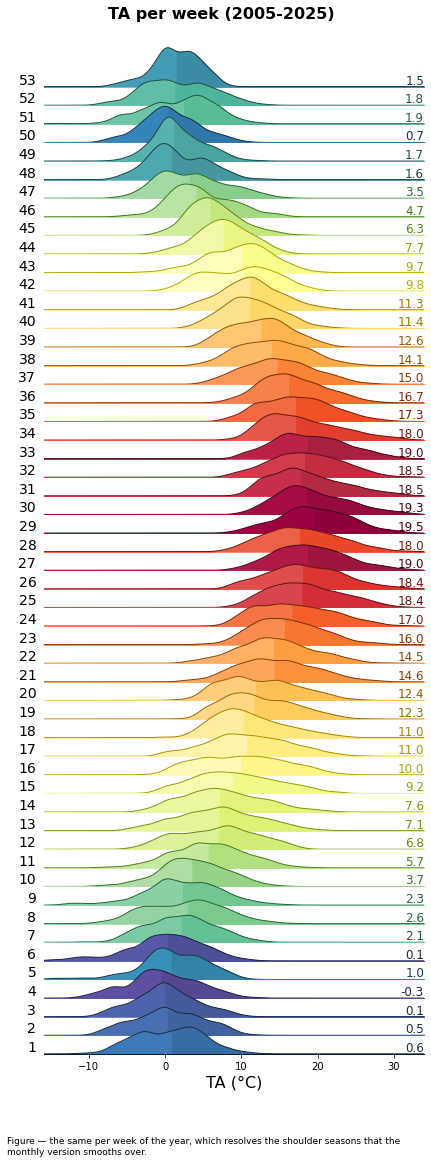
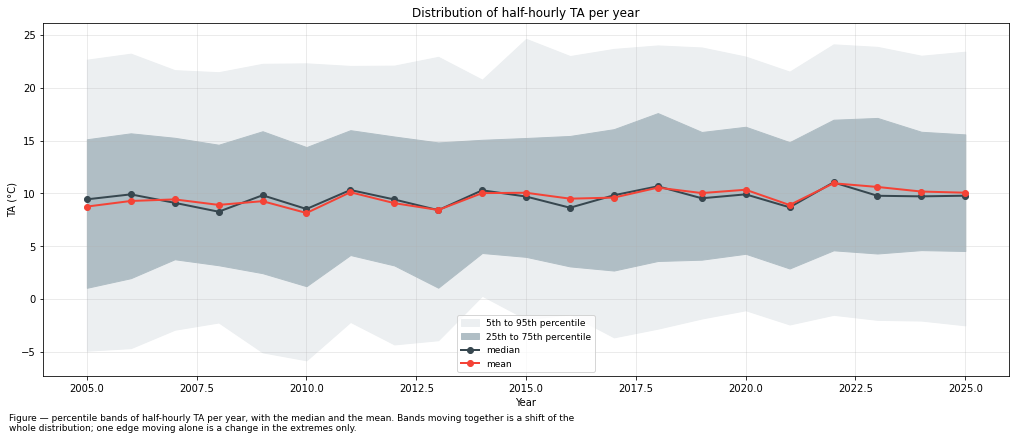
Percentiles per year
# Quantiles of the half-hourly values per year. The ridgelines above show the shape of each year's
# distribution; this shows where its edges moved. A shift of the median with unchanged 5th and 95th
# percentiles is a different signal from a spread that widens at one end only.
QUANTILES = [0.05, 0.25, 0.5, 0.75, 0.95]
quantiles = series.groupby(series.index.year).quantile(QUANTILES).unstack()
quantiles.index.name = "YEAR"

fig, ax = plt.subplots(figsize=(14, 6), dpi=72, layout="constrained")
ax.fill_between(quantiles.index, quantiles[0.05], quantiles[0.95], color='#ECEFF1',
                label="5th to 95th percentile")
ax.fill_between(quantiles.index, quantiles[0.25], quantiles[0.75], color='#B0BEC5',
                label="25th to 75th percentile")
ax.plot(quantiles.index, quantiles[0.5], color='#37474F', lw=2, marker='o', label="median")
ax.plot(ym.index, ym, color='#F44336', lw=2, marker='o', label="mean")
ax.set_xlabel("Year")
ax.set_ylabel(xlabel)
ax.set_title(f"Distribution of half-hourly {var} per year")
ax.grid(alpha=0.3)
ax.legend(fontsize=9)
figcap(fig, f"percentile bands of half-hourly {var} per year, with the median and the mean. Bands "
            f"moving together is a shift of the whole distribution; one edge moving alone is a change "
            f"in the extremes only.")
fig.show()

_table = quantiles.copy()
_table.columns = [f"{int(q * 100)}th percentile ({units})" for q in _table.columns]
display(styled(_table, caption=f"percentiles of half-hourly {var} per year, the numbers behind the bands: "
                       f"whether a year moved as a whole or only at one end", axis=None))
Table — percentiles of half-hourly TA per year, the numbers behind the bands: whether a year moved
as a whole or only at one end
| 5th percentile (°C) | 25th percentile (°C) | 50th percentile (°C) | 75th percentile (°C) | 95th percentile (°C) | |
|---|---|---|---|---|---|
| YEAR | |||||
| 2005 | -4.9 | 1.1 | 9.4 | 15.1 | 22.6 |
| 2006 | -4.6 | 2.0 | 9.9 | 15.7 | 23.2 |
| 2007 | -2.9 | 3.8 | 9.1 | 15.3 | 21.7 |
| 2008 | -2.2 | 3.2 | 8.3 | 14.6 | 21.5 |
| 2009 | -5.0 | 2.4 | 9.8 | 15.9 | 22.3 |
| 2010 | -5.8 | 1.2 | 8.5 | 14.4 | 22.3 |
| 2011 | -2.2 | 4.2 | 10.3 | 16.0 | 22.1 |
| 2012 | -4.3 | 3.2 | 9.4 | 15.4 | 22.1 |
| 2013 | -3.9 | 1.1 | 8.4 | 14.8 | 22.9 |
| 2014 | 0.3 | 4.4 | 10.3 | 15.1 | 20.8 |
| 2015 | -1.9 | 4.0 | 9.7 | 15.2 | 24.6 |
| 2016 | -1.4 | 3.1 | 8.6 | 15.4 | 23.0 |
| 2017 | -3.6 | 2.7 | 9.8 | 16.1 | 23.7 |
| 2018 | -2.8 | 3.6 | 10.7 | 17.6 | 24.0 |
| 2019 | -1.8 | 3.7 | 9.5 | 15.8 | 23.8 |
| 2020 | -1.1 | 4.3 | 9.9 | 16.3 | 22.9 |
| 2021 | -2.4 | 2.9 | 8.7 | 14.8 | 21.5 |
| 2022 | -1.5 | 4.6 | 11.0 | 17.0 | 24.1 |
| 2023 | -2.0 | 4.3 | 9.8 | 17.1 | 23.9 |
| 2024 | -2.0 | 4.6 | 9.7 | 15.8 | 23.0 |
| 2025 | -2.5 | 4.5 | 9.8 | 15.6 | 23.4 |
Heatmap plots
Half-hourly
fig, axs = plt.subplots(ncols=1, figsize=(6, 12), dpi=72, layout="constrained")
dv.plotting.HeatmapDateTime(series=series).plot(ax=axs, cb_digits_after_comma=0)
figcap(fig, f"half-hourly {var} over the whole record, time of day against date. The seasonal and the "
            f"diurnal cycle are both visible at this resolution, as is any period that behaves "
            f"differently from the dates around it.")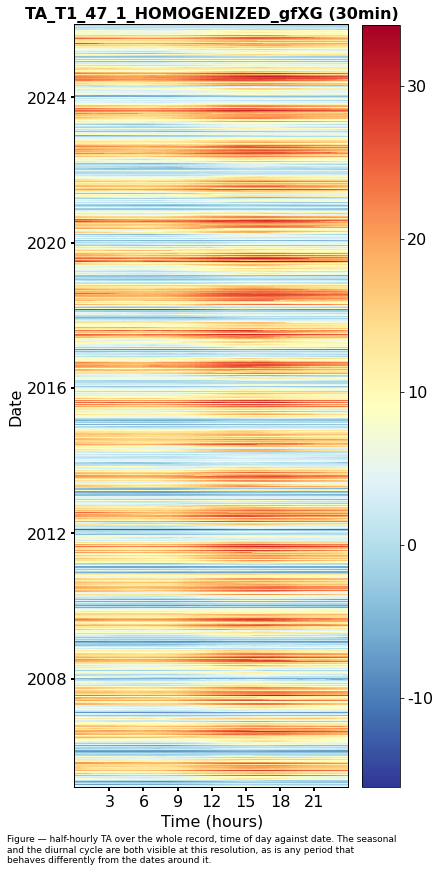
Monthly
fig, axs = plt.subplots(ncols=4, figsize=(21, 7), dpi=120, layout="constrained")
fig.suptitle(f'Per month', fontsize=32)

# HeatmapYearMonth aggregates the half-hourly series itself, so it is passed unresampled.
for _ax, _agg, _label in [(axs[0], 'mean', "monthly mean"),
                          (axs[1], 'min', "monthly minimum"),
                          (axs[2], 'max', "monthly maximum")]:
    dv.plotting.HeatmapYearMonth(series=series, agg=_agg).plot(
        ax=_ax, cb_digits_after_comma=0, zlabel=_label,
        format_style=dv.plotting.FormatStyle(title=_label))

# There is no 'range' aggregation, so the range is computed from the max and min year-month
# matrices and drawn on the same grid with HeatmapXYZ.
_range = (dv.plotting.HeatmapYearMonth(series=series, agg='max').get_plot_data()
          - dv.plotting.HeatmapYearMonth(series=series, agg='min').get_plot_data())
_range_lf = _range.stack().rename("monthly range").reset_index()
dv.plotting.HeatmapXYZ(x=_range_lf['MONTH'], y=_range_lf['YEAR'], z=_range_lf["monthly range"]).plot(
    ax=axs[3], cb_digits_after_comma=0, zlabel="monthly range",
    format_style=dv.plotting.FormatStyle(title="monthly range"))
figcap(fig, f"monthly mean, minimum, maximum and range of {var} by year and month. The range panel is "
            f"the difference of the two panels beside it and shows how far a month spread, "
            f"independently of the level it sat at.")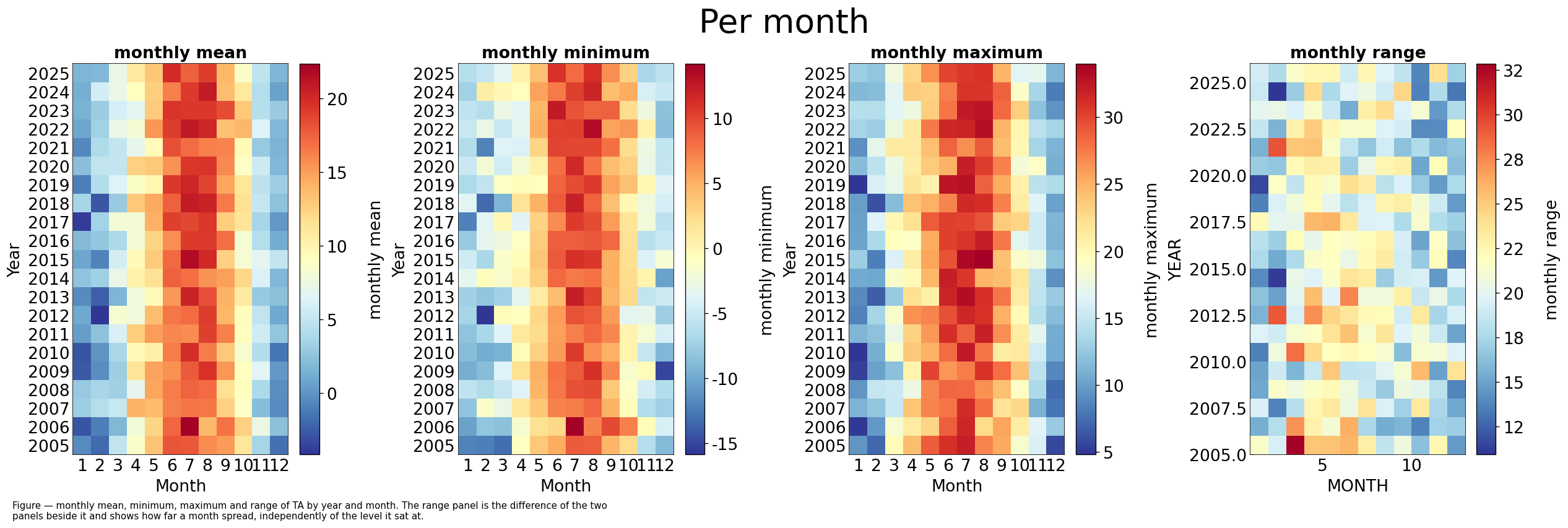
Monthly ranks
# Figure
fig = plt.figure(facecolor='white', figsize=(17, 6))

# Gridspec for layout
gs = gridspec.GridSpec(1, 4)  # rows, cols
gs.update(wspace=0.35, hspace=0.3, left=0.03, right=0.97, top=0.97, bottom=0.03)
ax_mean = fig.add_subplot(gs[0, 0])
ax_mean_ranks = fig.add_subplot(gs[0, 1])
ax_max = fig.add_subplot(gs[0, 2])
ax_max_ranks = fig.add_subplot(gs[0, 3])
style = dv.plotting.FormatStyle(axlabel_fontsize=10, ticks_fontsize=10)
params = {'show_values': True, 'cb_labelsize': 10, 'format_style': style}

dv.plotting.HeatmapYearMonth(series=series, agg='mean', ranks=False).plot(
    ax=ax_mean, zlabel="°C", cmap="RdYlBu_r", **params)

# Kept as a name: the ranks matrix is read back out of it further down.
hm_mean_ranks = dv.plotting.HeatmapYearMonth(series=series, agg='mean', ranks=True)
hm_mean_ranks.plot(ax=ax_mean_ranks, **params)

dv.plotting.HeatmapYearMonth(series=series, agg='max', ranks=False).plot(
    ax=ax_max, zlabel="°C", cmap="RdYlBu_r", **params)
dv.plotting.HeatmapYearMonth(series=series, agg='max', ranks=True).plot(
    ax=ax_max_ranks, **params)

ax_mean.set_title("Air temperature mean", color='black')
ax_mean_ranks.set_title("Air temperature mean: ranks", color='black')
ax_max.set_title("Air temperature max", color='black')
ax_max_ranks.set_title("Air temperature max: ranks", color='black')

ax_mean.tick_params(left=True, right=False, top=False, bottom=True,
                    labelleft=True, labelright=False, labeltop=False, labelbottom=True)
ax_mean_ranks.tick_params(left=True, right=False, top=False, bottom=True,
                   labelleft=False, labelright=False, labeltop=False, labelbottom=True)
ax_max.tick_params(left=True, right=False, top=False, bottom=True,
                     labelleft=False, labelright=False, labeltop=False, labelbottom=True)
ax_max_ranks.tick_params(left=True, right=False, top=False, bottom=True,
                     labelleft=False, labelright=False, labeltop=False, labelbottom=True)

ax_mean_ranks.set_ylabel("")
figcap(fig, f"monthly mean and monthly maximum {var}, each next to the same matrix expressed as ranks "
            f"across years. Ranks remove the size of an anomaly and leave only its order, which makes "
            f"a month that is consistently at one end of the record easy to see.")
ax_max.set_ylabel("")
ax_max_ranks.set_ylabel("")

fig.show()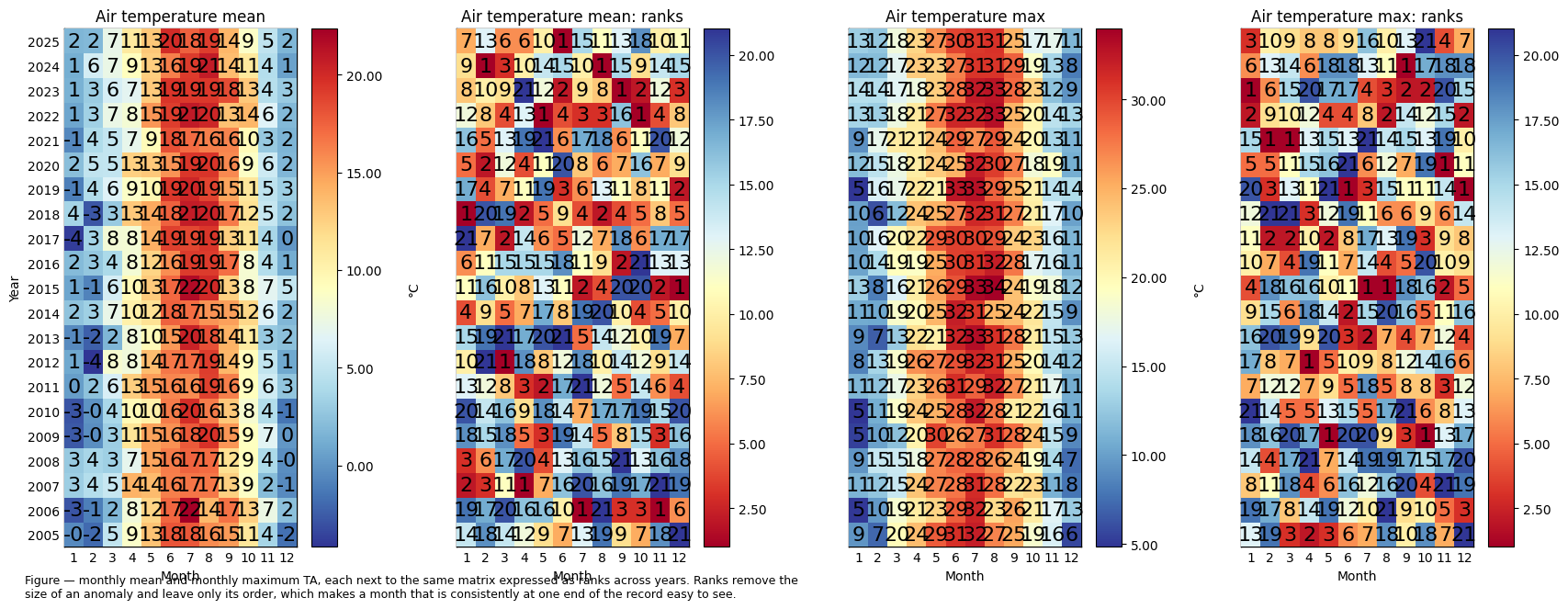
Mean ranks per year
_ax = hm_mean_ranks.get_plot_data().mean(axis=1).plot(title="Mean ranks per year")
figcap(_ax.get_figure(), "mean of the twelve monthly ranks per year. A rank-based summary of the "
                         "year, insensitive to how large a single monthly anomaly was.")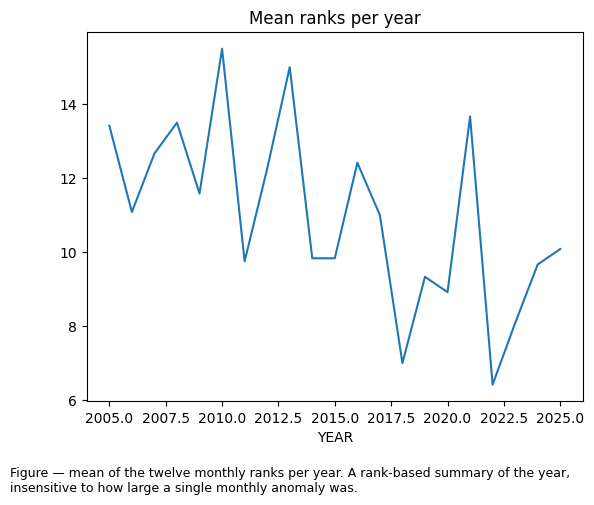
Anomalies and trends
Per year
# Reference period from the Settings cell. It spans the whole record here, so the anomalies are
# departures from the record's own mean rather than from a climate normal such as 1991-2020, which
# this dataset is too short to provide.
series_label = f"CH-LAE: {varname}"
_anomalies_year = LongtermAnomaliesYear(series=ym,
                                        series_label=series_label,
                                        series_units=units,
                                        reference_start_year=REFERENCE_START_YEAR,
                                        reference_end_year=REFERENCE_END_YEAR)
_anomalies_year.plot()
figcap(_anomalies_year.fig,
       f"yearly mean {var} as a departure from the reference period set in Settings, red above and "
       f"blue below it. The box states the reference mean and the mean of the last ten years.")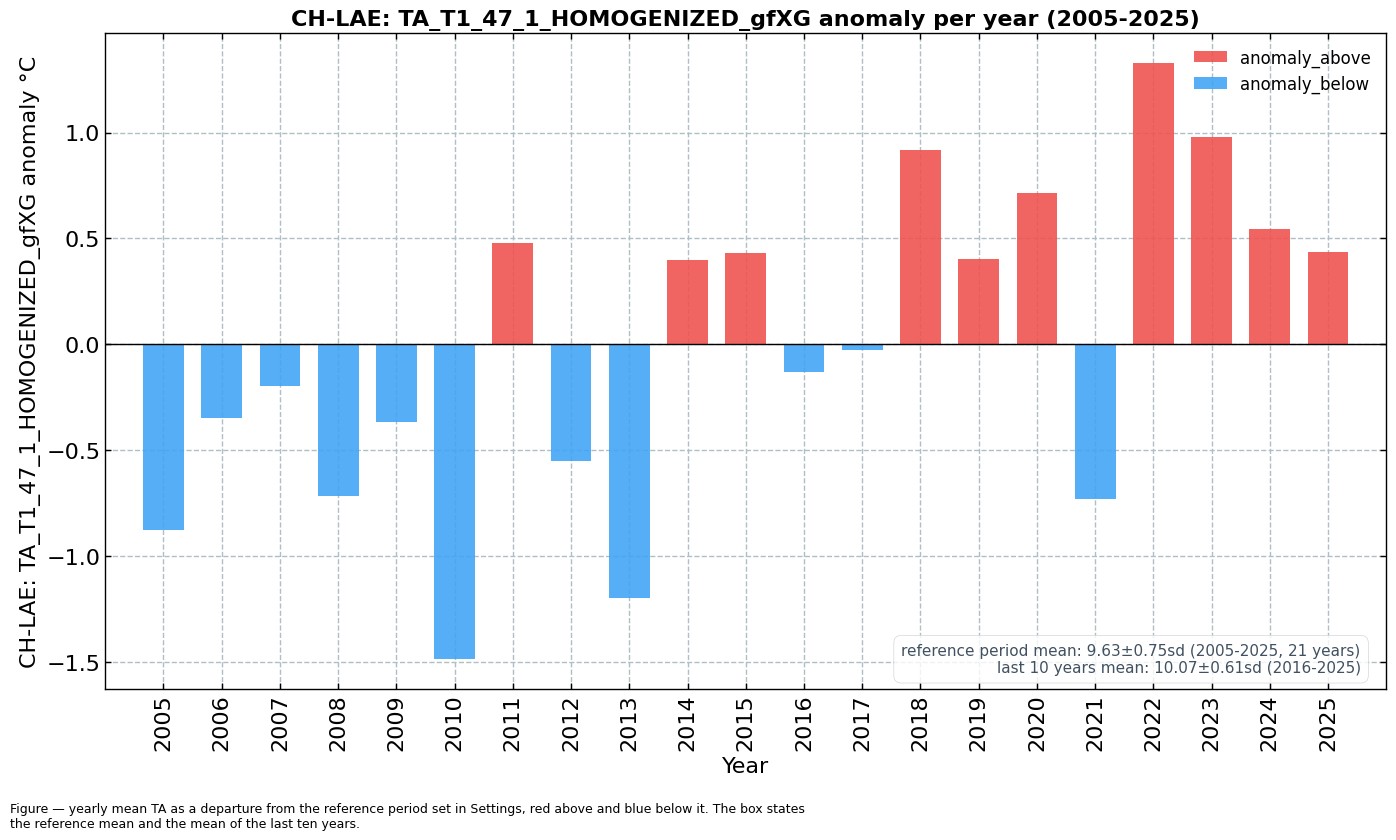
Per calendar month
# The same calculation per calendar month, each against the mean of that month over the reference
# period. A single month can run against the year it sits in, which the yearly plot cannot show.
monthly_by_number = per_year_month(series, 'mean', month_names=False)

fig, axs = plt.subplots(nrows=4, ncols=3, figsize=(22, 20), dpi=72, layout="constrained")
fig.suptitle(f"{varname}: anomaly per calendar month, reference "
             f"{REFERENCE_START_YEAR}-{REFERENCE_END_YEAR}", fontsize=22)
for _month, _ax in zip(monthly_by_number.columns, axs.flatten()):
    LongtermAnomaliesYear(series=monthly_by_number[_month].rename(varname),
                          series_label=calendar.month_name[_month],
                          series_units=units,
                          reference_start_year=REFERENCE_START_YEAR,
                          reference_end_year=REFERENCE_END_YEAR).plot(
        ax=_ax, format_style=dv.plotting.FormatStyle(title=calendar.month_name[_month],
                                                     axlabel_fontsize=10, ticks_fontsize=9))
figcap(fig, f"the yearly anomaly repeated per calendar month, each against the mean of that month "
            f"over the reference period. A single month can run against the year it sits in, which "
            f"the yearly plot cannot show.")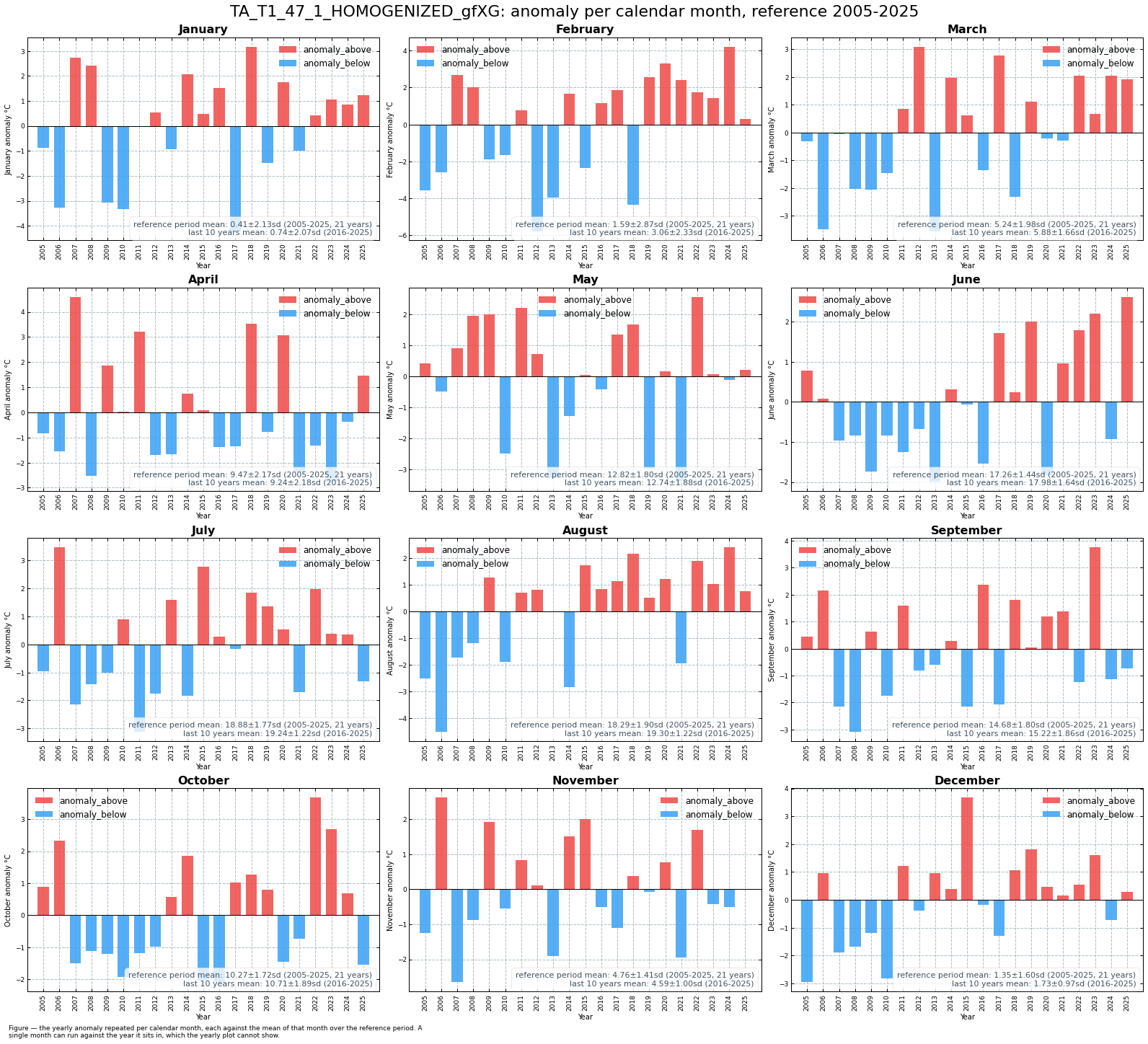
Anomaly by year and month
# All twelve panels above on one grid, plus the table behind them. Blue and red are equal distances
# from zero, so a column can be compared with any other column.
anomalies = monthly_avg - monthly_avg.loc[REFERENCE_START_YEAR:REFERENCE_END_YEAR].mean()
_long = monthly_by_number.sub(
    monthly_by_number.loc[REFERENCE_START_YEAR:REFERENCE_END_YEAR].mean()).stack().rename("z").reset_index()
_long.columns = ['YEAR', 'MONTH', 'z']
_absmax = _long['z'].abs().max()

fig, ax = plt.subplots(figsize=(9, 12), dpi=72, layout="constrained")
dv.plotting.HeatmapXYZ(x=_long['MONTH'], y=_long['YEAR'], z=_long['z']).plot(
    ax=ax, cmap='RdBu_r', vmin=-_absmax, vmax=_absmax, cb_digits_after_comma=1,
    xlabel="Month", ylabel="Year", zlabel=f"anomaly ({units})",
    format_style=dv.plotting.FormatStyle(title=f"Monthly {var} anomaly"))
figcap(fig, f"the twelve panels above on one grid, month against year. Blue and red are equal "
            f"distances from zero, so a column can be compared with any other column and a run of "
            f"warm months reads as a block.")

display(styled(anomalies, caption=f"monthly {var} anomaly ({units}) against "
                                  f"{REFERENCE_START_YEAR}-{REFERENCE_END_YEAR}, the numbers "
                                  f"behind the grid above",
               cmap='RdBu_r', axis=None, center=True))
Table — monthly TA anomaly (°C) against 2005-2025, the numbers behind the grid above
| Jan | Feb | Mar | Apr | May | Jun | Jul | Aug | Sep | Oct | Nov | Dec | |
|---|---|---|---|---|---|---|---|---|---|---|---|---|
| YEAR | ||||||||||||
| 2005 | -0.9 | -3.6 | -0.3 | -0.8 | 0.4 | 0.8 | -1.0 | -2.5 | 0.5 | 0.9 | -1.3 | -3.0 |
| 2006 | -3.3 | -2.6 | -3.5 | -1.6 | -0.5 | 0.1 | 3.5 | -4.5 | 2.2 | 2.3 | 2.6 | 1.0 |
| 2007 | 2.7 | 2.7 | -0.1 | 4.6 | 0.9 | -1.0 | -2.1 | -1.7 | -2.1 | -1.5 | -2.7 | -1.9 |
| 2008 | 2.4 | 2.0 | -2.0 | -2.5 | 2.0 | -0.8 | -1.4 | -1.2 | -3.1 | -1.1 | -0.9 | -1.7 |
| 2009 | -3.1 | -1.9 | -2.1 | 1.9 | 2.0 | -1.7 | -1.0 | 1.3 | 0.6 | -1.2 | 1.9 | -1.2 |
| 2010 | -3.3 | -1.7 | -1.5 | 0.0 | -2.5 | -0.8 | 0.9 | -1.9 | -1.8 | -1.9 | -0.6 | -2.8 |
| 2011 | -0.0 | 0.8 | 0.8 | 3.2 | 2.2 | -1.3 | -3.1 | 0.7 | 1.6 | -1.2 | 0.8 | 1.2 |
| 2012 | 0.5 | -5.8 | 3.1 | -1.7 | 0.7 | -0.7 | -1.8 | 0.8 | -0.8 | -1.0 | 0.1 | -0.4 |
| 2013 | -0.9 | -3.9 | -3.6 | -1.7 | -3.3 | -2.0 | 1.6 | 0.0 | -0.6 | 0.6 | -1.9 | 0.9 |
| 2014 | 2.1 | 1.7 | 2.0 | 0.8 | -1.3 | 0.3 | -1.8 | -2.8 | 0.3 | 1.9 | 1.5 | 0.4 |
| 2015 | 0.5 | -2.4 | 0.6 | 0.1 | 0.1 | -0.1 | 2.8 | 1.7 | -2.2 | -2.0 | 2.0 | 3.7 |
| 2016 | 1.5 | 1.2 | -1.3 | -1.4 | -0.4 | -1.5 | 0.3 | 0.9 | 2.4 | -2.1 | -0.5 | -0.2 |
| 2017 | -4.2 | 1.9 | 2.8 | -1.4 | 1.4 | 1.7 | -0.2 | 1.1 | -2.1 | 1.0 | -1.1 | -1.3 |
| 2018 | 3.2 | -4.4 | -2.3 | 3.5 | 1.7 | 0.2 | 1.9 | 2.2 | 1.8 | 1.3 | 0.4 | 1.1 |
| 2019 | -1.5 | 2.6 | 1.1 | -0.8 | -3.0 | 2.0 | 1.4 | 0.5 | 0.1 | 0.8 | -0.1 | 1.8 |
| 2020 | 1.7 | 3.3 | -0.2 | 3.1 | 0.2 | -1.8 | 0.5 | 1.2 | 1.2 | -1.4 | 0.8 | 0.5 |
| 2021 | -1.0 | 2.4 | -0.3 | -2.4 | -3.4 | 1.0 | -1.7 | -2.0 | 1.4 | -0.7 | -1.9 | 0.2 |
| 2022 | 0.4 | 1.7 | 2.0 | -1.3 | 2.6 | 1.8 | 2.0 | 1.9 | -1.2 | 3.7 | 1.7 | 0.5 |
| 2023 | 1.1 | 1.4 | 0.7 | -2.8 | 0.1 | 2.2 | 0.4 | 1.0 | 3.8 | 2.7 | -0.4 | 1.6 |
| 2024 | 0.8 | 4.2 | 2.1 | -0.4 | -0.1 | -0.9 | 0.4 | 2.4 | -1.1 | 0.7 | -0.5 | -0.7 |
| 2025 | 1.2 | 0.3 | 1.9 | 1.5 | 0.2 | 2.6 | -1.3 | 0.8 | -0.7 | -1.5 | 0.0 | 0.3 |
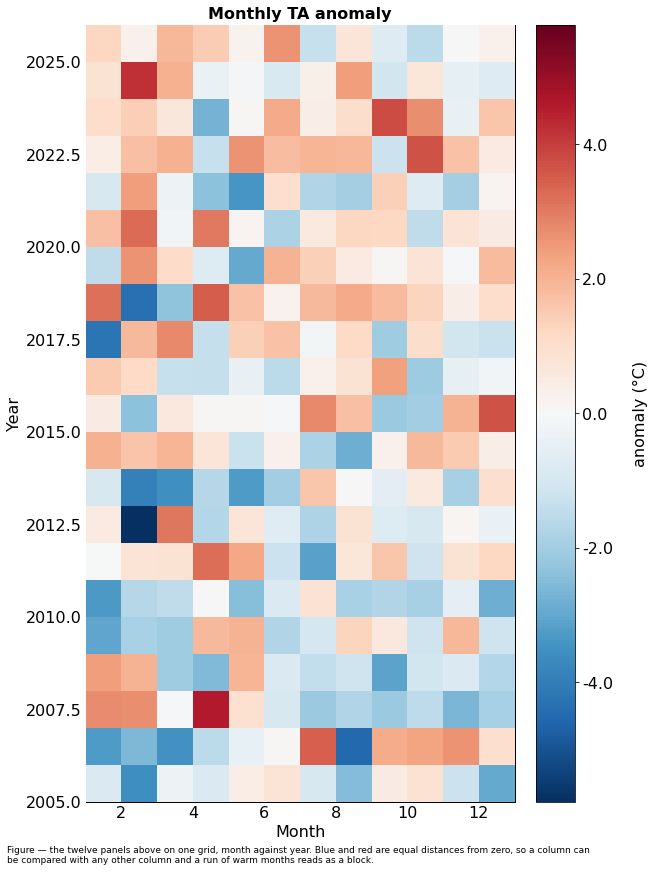
Stripes
# The yearly anomalies as stripes: the same numbers as the bar plot above, in the form the figure
# is usually published in. One bar per year, no axis, colour is the whole message.
_anomaly = ym - ym.loc[REFERENCE_START_YEAR:REFERENCE_END_YEAR].mean()
_absmax = _anomaly.abs().max()
_cmap = plt.get_cmap('RdBu_r')
_norm = Normalize(vmin=-_absmax, vmax=_absmax)

fig, ax = plt.subplots(figsize=(14, 4), dpi=72, layout="constrained")
ax.bar(_anomaly.index, height=1.0, width=1.0, color=_cmap(_norm(_anomaly.to_numpy())))
ax.set_xlim(_anomaly.index.min() - 0.5, _anomaly.index.max() + 0.5)
ax.set_ylim(0, 1)
ax.set_yticks([])
ax.set_xlabel("Year")
ax.set_title(f"{var} anomaly per year against {REFERENCE_START_YEAR}-{REFERENCE_END_YEAR}")
fig.colorbar(plt.cm.ScalarMappable(norm=_norm, cmap=_cmap), ax=ax, label=f"anomaly ({units})")
figcap(fig, f"the yearly anomalies as stripes, one bar per year and colour as the only encoding. The "
            f"same numbers as the anomaly plot above, in the form the figure is usually published in.")
fig.show()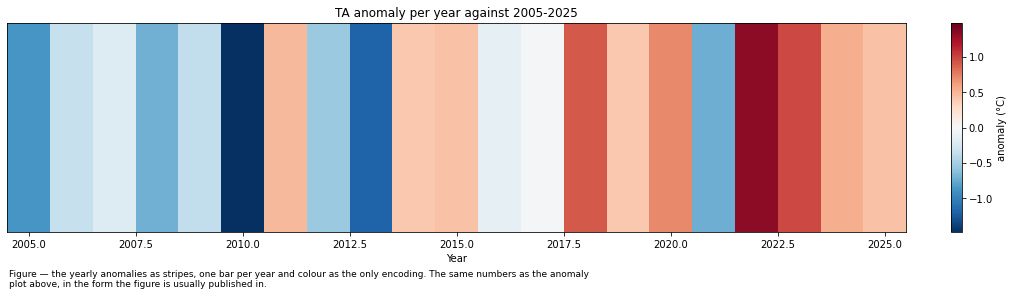
Trend of the yearly means
# Trend of the yearly means. Theil-Sen for the slope and Kendall's tau for the significance, see
# the `trend` helper for why. The interval is the 95 % interval of the slope, not of the yearly
# values, and a trend over 21 years is a statement about this record, not a climate projection.
_fit = trend(ym)
print(f"Theil-Sen slope: {_fit['slope']:+.2f} {units} per decade "
      f"(95 % interval {_fit['low']:+.2f} to {_fit['high']:+.2f})")
print(f"Kendall tau:     {_fit['tau']:+.2f} (p = {_fit['pvalue']:.4f})")

fig, ax = plt.subplots(figsize=(14, 6), dpi=72, layout="constrained")
ax.plot(ym.index, ym, marker='o', color='#37474F', lw=1.5, label="yearly mean")
ax.plot(_fit['fit'].index, _fit['fit'], color='#F44336', lw=2,
        label=f"Theil-Sen: {_fit['slope']:+.2f} {units}/decade (p = {_fit['pvalue']:.4f})")
ax.set_xlabel("Year")
ax.set_ylabel(xlabel)
ax.set_title(f"Yearly mean {var} and its trend")
ax.grid(alpha=0.3)
ax.legend(fontsize=9)
figcap(fig, f"yearly mean {var} with its Theil-Sen trend; slope, interval and p are printed above the "
            f"figure. A trend over this record is a statement about these years, not a projection.")
fig.show()
Theil-Sen slope: +0.76 °C per decade (95 % interval +0.34 to +1.28)
Kendall tau: +0.47 (p = 0.0026)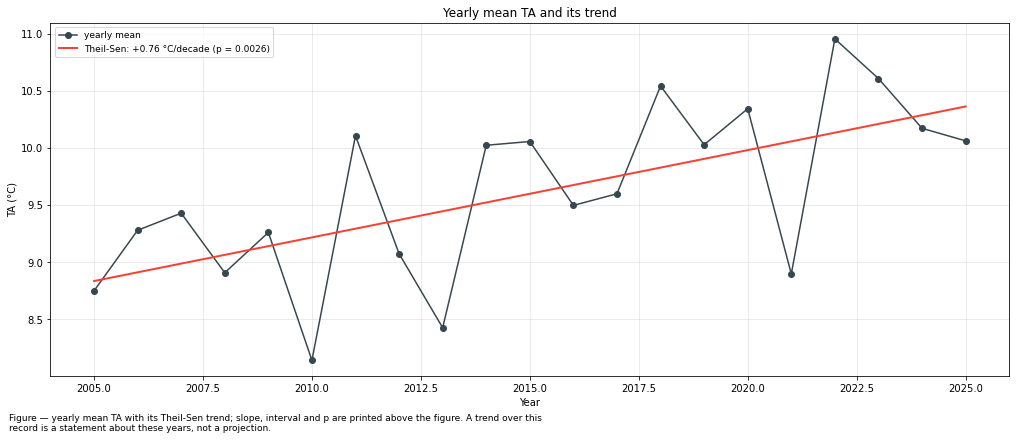
Trend per calendar month
# The same slope fitted to each calendar month separately: which part of the year carries the
# warming. Bars are drawn solid where Kendall's tau is significant at p < 0.05 and hollow where it
# is not; twelve tests on one record means a single significant month is weak evidence on its own.
_rows = {}
for _month in monthly_by_number.columns:
    _fit = trend(monthly_by_number[_month])
    _rows[calendar.month_abbr[_month]] = {
        f"trend ({units}/decade)": _fit['slope'],
        f"lower 95 % ({units}/decade)": _fit['low'],
        f"upper 95 % ({units}/decade)": _fit['high'],
        "p": _fit['pvalue'],
    }
trends = pd.DataFrame.from_dict(_rows, orient='index')
trends.index.name = "MONTH"

_fmt = {c: "{:.2f}" for c in trends.columns}
_fmt["p"] = "{:.4f}"
display(styled(trends, caption=f"Theil-Sen trend of monthly mean {var} per calendar month with its 95 % "
                       f"interval and Kendall p. Twelve tests on one record, so a single "
                       f"significant month is weak evidence on its own", fmt=_fmt,
               subset=[f"trend ({units}/decade)"], cmap='RdBu_r', center=True))

_slope = trends[f"trend ({units}/decade)"]
_significant = trends["p"] < 0.05
fig, ax = plt.subplots(figsize=(14, 5), dpi=72, layout="constrained")
ax.bar(trends.index, _slope, color=['#EF5350' if s else 'white' for s in _significant],
       edgecolor='#EF5350', lw=1.5)
ax.errorbar(trends.index, _slope,
            yerr=[_slope - trends[f"lower 95 % ({units}/decade)"],
                  trends[f"upper 95 % ({units}/decade)"] - _slope],
            fmt='none', ecolor='#37474F', capsize=4, lw=1)
ax.axhline(0, color='#37474F', lw=1)
ax.set_xlabel("Month")
ax.set_ylabel(f"{units} per decade")
ax.set_title(f"Trend of monthly mean {var} (solid = significant at p < 0.05)")
ax.grid(alpha=0.3, axis='y')
figcap(fig, f"Theil-Sen trend of monthly mean {var} per calendar month with its 95 % interval; solid "
            f"bars are significant at p < 0.05. It shows which part of the year carries the yearly "
            f"trend.")
fig.show()
Table — Theil-Sen trend of monthly mean TA per calendar month with its 95 % interval and Kendall p.
Twelve tests on one record, so a single significant month is weak evidence on its own
| trend (°C/decade) | lower 95 % (°C/decade) | upper 95 % (°C/decade) | p | |
|---|---|---|---|---|
| MONTH | ||||
| Jan | 0.81 | -0.87 | 2.61 | 0.4550 |
| Feb | 2.34 | -0.19 | 4.19 | 0.0852 |
| Mar | 1.50 | 0.04 | 2.91 | 0.0420 |
| Apr | -0.19 | -2.14 | 1.28 | 0.8815 |
| May | -0.28 | -1.67 | 1.02 | 0.6982 |
| Jun | 1.17 | -0.01 | 2.25 | 0.0564 |
| Jul | 0.50 | -1.11 | 2.01 | 0.4921 |
| Aug | 1.79 | 0.48 | 2.93 | 0.0074 |
| Sep | 0.59 | -0.94 | 1.91 | 0.5306 |
| Oct | 0.40 | -0.67 | 2.27 | 0.5306 |
| Nov | 0.10 | -1.26 | 1.35 | 0.8815 |
| Dec | 1.16 | -0.12 | 2.41 | 0.0745 |
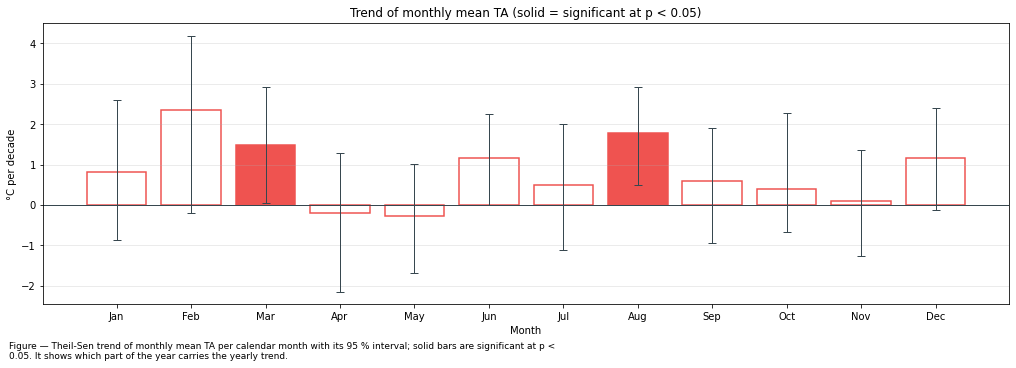
Cumulative plot
_cumulative = CumulativeYear(
    series=series,
    series_units=units,
    start_year=FIRST_YEAR,
    end_year=LAST_YEAR,
    show_reference=True,
    excl_years_from_reference=None,
    highlight_year=LAST_YEAR)
_cumulative.plot(highlight_year_color='#F44336')
figcap(_cumulative.fig,
       f"{var} accumulated over the course of each year, against the mean of all years and with the "
       f"most recent year highlighted. A year that departs early and keeps its distance separates "
       f"from the bundle; one that recovers rejoins it.")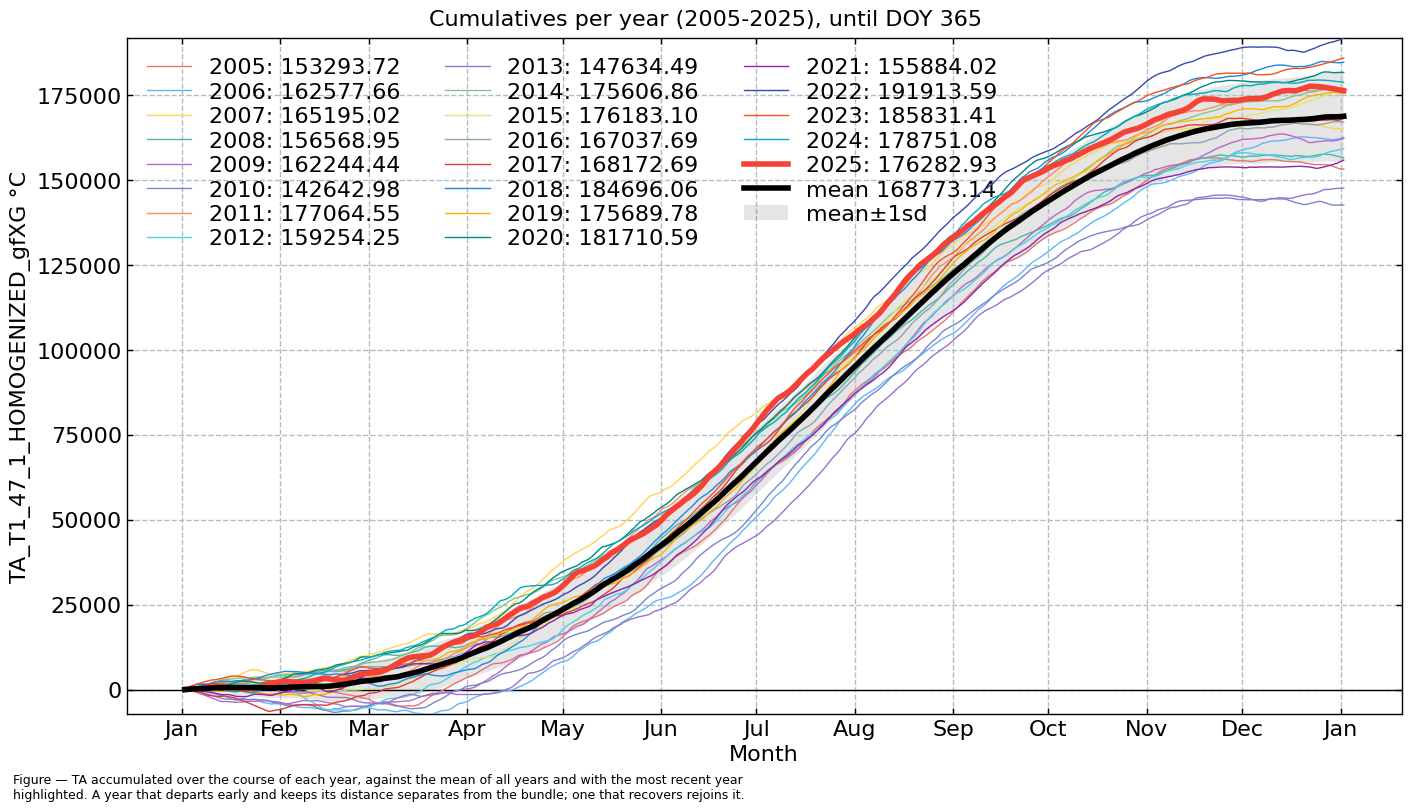
Comparison with the MeteoSwiss reference station
This is the comparison that found the 2016 sensor change, and it is now the check on what the homogenisation did and did not achieve. The MeteoSwiss station Lägern is 2.5 km from the tower at 845 m a.s.l. and is operated by a different institution, so the difference against it removes the weather and leaves the instruments. The elevation difference means a constant offset is expected; what matters is whether that offset stays constant.
The residual is split into night and day below, and the split is the point. The two corrections the product carries were derived on different evidence and act at different times of day: the constant was derived at night, where a radiation-shield error cannot contribute, and the shield term was derived against the aspirated NABEL sensor and acts only in sunlight. The night residual therefore tests the first and the day residual the second. Neither should step across 21 January 2016, and what remains of either is the residual this product carries.
# The reference product is written by 10_METEO/10_REFERENCE and is stored on TIMESTAMP_END, so it
# is shifted onto the product's TIMESTAMP_MIDDLE before anything is compared.
REFDIR = r"F:\Sync\luhk_work\dev-data\datasets-data\dataset_ch-lae_flux_product-data\workflow\10_METEO\10_REFERENCE"
REFFILE = "MeteoSwiss_LAE_30MIN_2004-2025.parquet"
_reference = pd.read_parquet(Path(REFDIR) / REFFILE)['TA_LAE_MS']
_reference.index = _reference.index - pd.Timedelta('15min')

# Measured records only, from both columns, so the step and its removal are visible side by side.
_meas = df[flagname] == 0
both = pd.concat([df.loc[_meas, varname_measured].rename('measured'),
                  df.loc[_meas, varname].rename('homogenised'),
                  _reference.rename('reference')], axis=1, sort=True).dropna()
assert len(both) > 100_000, f"only {len(both)} overlapping half-hours with the reference station"

residual = (both['homogenised'] - both['reference']).rename('residual')
print(f"Overlap:  {len(both):,} measured half-hours, "
      f"{both.index[0]:%Y-%m-%d} to {both.index[-1]:%Y-%m-%d}")
for _name in ('measured', 'homogenised'):
    _r = both[_name] - both['reference']
    print(f"Residual ({_name:12s}): {_r.mean():+.2f} {units} +/- {_r.std():.2f} {units} SD")
print(f"Correlation: r = {both['homogenised'].corr(both['reference']):.4f}")

# The step across the sensor change, before and after homogenisation. Complete years either side,
# so the January 2016 outage does not sit inside a compared window.
_break_year = int(df.index[df[sourcename] == 0][0].year)
for _name in ('measured', 'homogenised'):
    _r = both[_name] - both['reference']
    _before = _r[(_r.index.year >= _break_year - 3) & (_r.index.year <= _break_year - 1)].mean()
    _after = _r[(_r.index.year >= _break_year + 1) & (_r.index.year <= _break_year + 3)].mean()
    print(f"Step at the sensor change ({_name:12s}): {_after - _before:+.2f} {units}")
Overlap: 363,913 measured half-hours, 2005-01-01 to 2025-12-31
Residual (measured ): +0.67 °C +/- 1.20 °C SD
Residual (homogenised ): +1.29 °C +/- 0.90 °C SD
Correlation: r = 0.9939
Step at the sensor change (measured ): +1.51 °C
Step at the sensor change (homogenised ): +0.03 °CResidual over time
# Left: the residual as monthly means, separately for night and day, each with a 12-month rolling
# median. Night is where the offset was derived and should show no step at the sensor change; day
# retains the difference between the two radiation shields, which no constant can correct.
# Right: the two series against each other, with the 1:1 line for orientation.
_pot = dv.variables.potrad(timestamp_index=both.index, lat=SITE_LAT, lon=SITE_LON,
                           utc_offset=TIMEZONE_OFFSET_TO_UTC_HOURS)
_is_night = _pot <= 0

fig, axs = plt.subplots(ncols=2, figsize=(17, 6), dpi=72, layout="constrained")
_break = df.index[df[sourcename] == 0][0]
axs[0].axvline(_break, color='#9E9E9E', lw=1.2, ls='--', label=f"sensor change {_break:%b %Y}")
for _label, _mask, _colour in [('night', _is_night, '#1565C0'), ('day', ~_is_night, '#EF6C00')]:
    _r = residual[_mask].resample('ME').mean()
    axs[0].plot(_r.index, _r, color=_colour, lw=0.8, alpha=0.35)
    axs[0].plot(_r.index, _r.rolling(12, center=True).median(), color=_colour, lw=2,
                label=f"{_label}, 12-month rolling median")
axs[0].set_xlabel("Year")
axs[0].set_ylabel(f"tower minus reference ({units})")
axs[0].set_title("Residual against MeteoSwiss LAE, homogenised column")
axs[0].grid(alpha=0.3)
axs[0].legend(fontsize=9)

_hb = axs[1].hexbin(both['reference'], both['homogenised'], gridsize=80, bins='log', cmap='viridis')
_line = [both.min().min(), both.max().max()]
axs[1].plot(_line, _line, color='#EF5350', lw=1.5, label="1:1")
axs[1].set_xlabel(f"MeteoSwiss LAE {var} ({units})")
axs[1].set_ylabel(f"CH-LAE tower {var}, homogenised ({units})")
axs[1].set_title("Half-hourly values against the reference")
axs[1].legend(fontsize=9)
fig.colorbar(_hb, ax=axs[1], label="records (log)")
figcap(fig, f"left: the residual of the homogenised column against the MeteoSwiss station, as "
            f"monthly means with a 12-month rolling median, split into night and day. The night "
            f"residual passes through the sensor change unchanged, which is what the homogenisation "
            f"was derived to achieve; the day residual steps upwards, because the two sensors' "
            f"radiation shields differ and a constant offset cannot correct a daytime-only error. "
            f"Right: the half-hourly values against each other with the 1:1 line, coloured by "
            f"record count.")

# The step, stated rather than left to the eye. Three complete years either side, so the January
# 2016 outage does not sit inside a compared window.
_yr = _break.year
_pre = (both.index.year >= _yr - 3) & (both.index.year <= _yr - 1)
_post = (both.index.year >= _yr + 1) & (both.index.year <= _yr + 3)
_rows = []
for _wname, _wmask in [('all hours', np.ones(len(both), bool)),
                       ('night', _is_night.to_numpy()), ('day', (~_is_night).to_numpy())]:
    for _col, _cname in [('measured', 'measured'), ('homogenised', 'homogenised')]:
        _r = both[_col] - both['reference']
        _rows.append({'window': _wname, 'column': _cname,
                      f'{_yr - 3}-{_yr - 1} ({units})': _r[_pre & _wmask].mean(),
                      f'{_yr + 1}-{_yr + 3} ({units})': _r[_post & _wmask].mean(),
                      f'step ({units})': _r[_post & _wmask].mean() - _r[_pre & _wmask].mean()})
display(styled(pd.DataFrame(_rows).set_index(['window', 'column']),
               caption=f"the step across the sensor change, measured against MeteoSwiss over three "
                       f"complete years either side. The homogenised column removes it at night and "
                       f"keeps most of it in the day, which is the limitation stated at the top of "
                       f"this notebook",
               fmt="{:.2f}", subset=[f'step ({units})'], cmap='RdBu_r', center=True))

_yearly_residual = pd.DataFrame({
    f"mean residual ({units})": per_year(residual, 'mean'),
    f"night ({units})": per_year(residual[_is_night], 'mean'),
    f"day ({units})": per_year(residual[~_is_night], 'mean'),
    f"SD ({units})": per_year(residual, 'std'),
    "overlapping half-hours": per_year(residual, 'count'),
})
_fmt = {c: "{:.2f}" for c in _yearly_residual.columns}
_fmt["overlapping half-hours"] = "{:.0f}"
display(styled(_yearly_residual, caption="residual of the homogenised column against the MeteoSwiss station per year, split into night and day. The night column is close to flat across the whole record, which is what supports the homogenisation; the day column carries the shield difference and steps at the sensor change", fmt=_fmt,
               subset=[f"night ({units})", f"day ({units})"], cmap='RdBu_r', center=True))
Table — the step across the sensor change, measured against MeteoSwiss over three complete years
either side. The homogenised column removes it at night and keeps most of it in the day, which is
the limitation stated at the top of this notebook
| 2013-2015 (°C) | 2017-2019 (°C) | step (°C) | ||
|---|---|---|---|---|
| window | column | |||
| all hours | measured | -0.01 | 1.50 | 1.51 |
| homogenised | 1.31 | 1.34 | 0.03 | |
| night | measured | -0.21 | 1.10 | 1.31 |
| homogenised | 1.11 | 1.10 | -0.01 | |
| day | measured | 0.18 | 1.87 | 1.69 |
| homogenised | 1.50 | 1.56 | 0.06 |
Table — residual of the homogenised column against the MeteoSwiss station per year, split into night
and day. The night column is close to flat across the whole record, which is what supports the
homogenisation; the day column carries the shield difference and steps at the sensor change
| mean residual (°C) | night (°C) | day (°C) | SD (°C) | overlapping half-hours | |
|---|---|---|---|---|---|
| YEAR | |||||
| 2005 | 1.27 | 1.10 | 1.42 | 0.82 | 17486 |
| 2006 | 1.11 | 0.91 | 1.28 | 1.00 | 17494 |
| 2007 | 1.16 | 0.99 | 1.32 | 0.97 | 17507 |
| 2008 | 1.22 | 1.09 | 1.34 | 0.81 | 17548 |
| 2009 | 1.21 | 1.01 | 1.40 | 0.88 | 17036 |
| 2010 | 1.35 | 1.20 | 1.49 | 0.66 | 17351 |
| 2011 | 1.37 | 1.14 | 1.59 | 0.91 | 17499 |
| 2012 | 1.40 | 1.19 | 1.60 | 0.78 | 16286 |
| 2013 | 1.35 | 1.13 | 1.54 | 0.89 | 17434 |
| 2014 | 1.32 | 1.14 | 1.49 | 0.73 | 17475 |
| 2015 | 1.27 | 1.05 | 1.47 | 0.88 | 17502 |
| 2016 | 1.45 | 1.08 | 1.77 | 1.13 | 16572 |
| 2017 | 1.32 | 0.95 | 1.66 | 1.00 | 17520 |
| 2018 | 1.35 | 1.20 | 1.49 | 0.82 | 17520 |
| 2019 | 1.35 | 1.15 | 1.52 | 0.84 | 16761 |
| 2020 | 1.24 | 0.99 | 1.47 | 0.96 | 17531 |
| 2021 | 1.33 | 1.20 | 1.46 | 0.86 | 17379 |
| 2022 | 1.46 | 1.30 | 1.61 | 0.80 | 17520 |
| 2023 | 1.29 | 1.19 | 1.39 | 0.76 | 17511 |
| 2024 | 1.08 | 0.96 | 1.20 | 0.96 | 17461 |
| 2025 | 1.19 | 1.08 | 1.29 | 1.08 | 17520 |
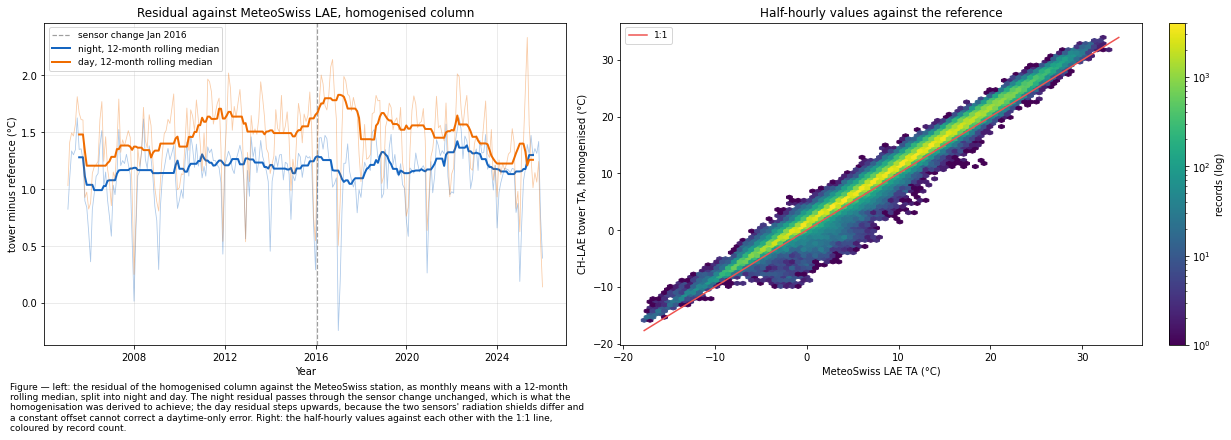
What the correction does to the shape of the day
The residual above is a half-hourly average. The statistics this notebook is mostly built from are daily ones, and a correction that acts only in daylight moves a daily maximum and a daily minimum by different amounts. Those steps are measured here rather than described, because the warnings at the head of this notebook and above the extremes rest on them.
Each statistic is formed on the product and on the reference station for the same day, and the step is the change in their difference across the sensor change. Days are used only where the product was measured for at least 44 of its 48 records and the reference is as complete, so a daily maximum is a real one rather than the maximum of whatever survived.
_break_ts = df.index[df[sourcename] == 0][0]
_pre_years = list(range(_break_ts.year - 3, _break_ts.year))
_post_years = list(range(_break_ts.year, _break_ts.year + 3))
_full_pre = [_y for _y in sorted(set(df.index.year)) if _y < _break_ts.year]
_full_post = [_y for _y in sorted(set(df.index.year)) if _y >= _break_ts.year]

# Days that are essentially measured in the product and complete in the reference.
MIN_RECORDS_PER_DAY = 44
_ok = ((df[flagname].eq(0).resample('D').sum() >= MIN_RECORDS_PER_DAY)
       & (_reference.resample('D').count() >= MIN_RECORDS_PER_DAY))
assert _ok.sum() > 3000, f"only {_ok.sum()} days are complete enough to compare"

_stats = {'daily maximum': lambda s: s.resample('D').max(),
          'daily minimum': lambda s: s.resample('D').min(),
          'diurnal range': lambda s: s.resample('D').max() - s.resample('D').min()}

_rows = []
for _stat, _fn in _stats.items():
    _b = _fn(_reference)[_ok]
    for _label, _col in [('as measured', varname_measured), ('homogenised', varname)]:
        _r = (_fn(df[_col])[_ok] - _b).dropna()
        _row = {'statistic': _stat, 'column': _label}
        for _wlabel, _wa, _wb in [(f'{_pre_years[0]}-{_pre_years[-1]} against '
                                   f'{_post_years[0]}-{_post_years[-1]}', _pre_years, _post_years),
                                  ('full eras', _full_pre, _full_post)]:
            _row[f'step, {_wlabel} ({units})'] = (_r[_r.index.year.isin(_wb)].mean()
                                                  - _r[_r.index.year.isin(_wa)].mean())
        _row['days'] = len(_r)
        _rows.append(_row)
daily_shape_steps = pd.DataFrame(_rows).set_index(['statistic', 'column'])
_step_cols = [c for c in daily_shape_steps.columns if c.startswith('step')]
display(styled(daily_shape_steps, caption="the step across the sensor change in the daily "
                                          "statistics, against the MeteoSwiss station, before and "
                                          "after the correction. The homogenised rows are what "
                                          "this product carries; the measured rows are what it "
                                          "would carry without the correction",
               fmt="{:.2f}", subset=_step_cols, cmap='RdBu_r', center=True))

# The correction has to improve every one of these, on both windows. It corrects a daytime error,
# so the daily maximum is the one it was expected to move most; if any statistic came out worse
# the warnings below would have to be rewritten rather than relaxed.
for _stat in _stats:
    for _c in _step_cols:
        _before = abs(daily_shape_steps.loc[(_stat, 'as measured'), _c])
        _after = abs(daily_shape_steps.loc[(_stat, 'homogenised'), _c])
        assert _after < _before, (
            f"the correction makes the {_stat} step worse on '{_c}' ({_before:.2f} -> {_after:.2f} "
            f"{units}) - the warnings in this notebook must be re-derived, not relaxed")

_worst = max(abs(daily_shape_steps.loc[(_s, 'homogenised'), _c])
             for _s in _stats for _c in _step_cols)
print(f"Largest residual step over the three daily statistics and both windows: {_worst:.2f} {units}.")
print(f"The same statistics on the measured column step by up to "
      f"{max(abs(daily_shape_steps.loc[(_s, 'as measured'), _c]) for _s in _stats for _c in _step_cols):.2f} {units}.")
Table — the step across the sensor change in the daily statistics, against the MeteoSwiss station,
before and after the correction. The homogenised rows are what this product carries; the measured
rows are what it would carry without the correction
| step, 2013-2015 against 2016-2018 (°C) | step, full eras (°C) | days | ||
|---|---|---|---|---|
| statistic | column | |||
| daily maximum | as measured | 1.90 | 1.60 | 7572.00 |
| homogenised | 0.21 | -0.08 | 7572.00 | |
| daily minimum | as measured | 1.39 | 1.43 | 7572.00 |
| homogenised | 0.03 | 0.06 | 7572.00 | |
| diurnal range | as measured | 0.51 | 0.16 | 7572.00 |
| homogenised | 0.18 | -0.14 | 7572.00 |
Largest residual step over the three daily statistics and both windows: 0.21 °C.
The same statistics on the measured column step by up to 1.90 °C.
Appendix: single-year detail
Two figures per year, drawn only when SHOW_PER_YEAR_DETAIL is set in the Settings cell. They repeat the distributions above year by year and are kept at the end because they are detail, not overview.
Single years per month
if SHOW_PER_YEAR_DETAIL:
    uniq_years = series.index.year.unique()
    for uy in uniq_years:
        series_yr = series.loc[series.index.year == uy].copy()
        rp = dv.plotting.RidgeLinePlot(series=series_yr)
        rp.plot(
            how='monthly',
            kd_kwargs=None,  # params from scikit KernelDensity as dict
            xlim=xlim,  # min/max as list
            ylim=[0, 0.18],  # min/max as list
            hspace=-0.6,  # overlap
            fig_width=6,
            fig_height=7,
            shade_percentile=0.5,
            show_mean_line=False,
            format_style=dv.plotting.FormatStyle(xlabel=xlabel, title=f"{var} per month ({uy})"),
            fig_dpi=72,
            showplot=True,
            ascending=False
        )
        figcap(rp.fig, f"distribution of half-hourly {var} per month in {uy}.")
F:\dev\diive\diive\core\plotting\ridgeline.py:153: RuntimeWarning: More than 20 figures have been opened. Figures created through the pyplot interface (`matplotlib.pyplot.figure`) are retained until explicitly closed and may consume too much memory. (To control this warning, see the rcParam `figure.max_open_warning`). Consider using `matplotlib.pyplot.close()`.
self.fig = plt.figure(figsize=(self.fig_width, self.fig_height),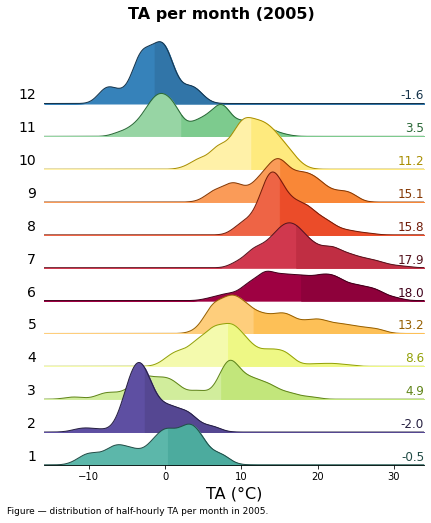
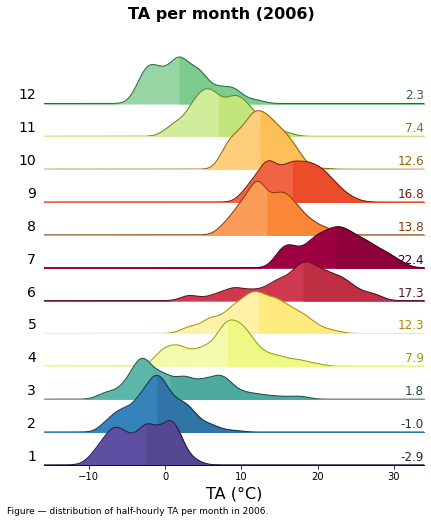
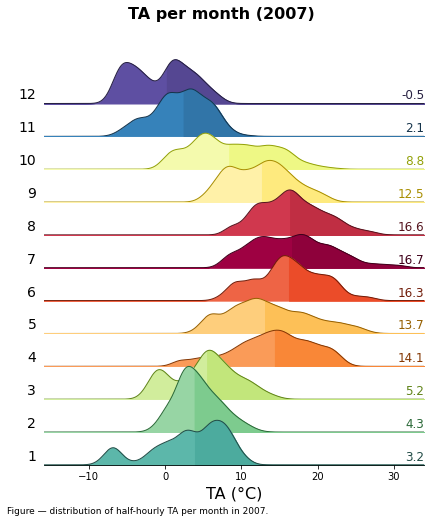
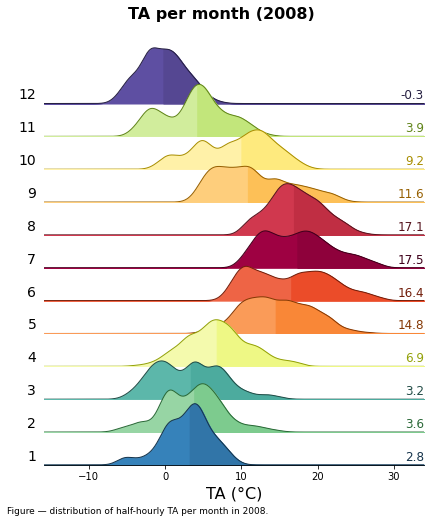
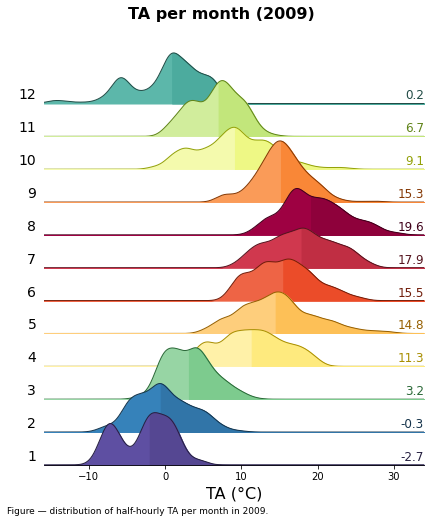
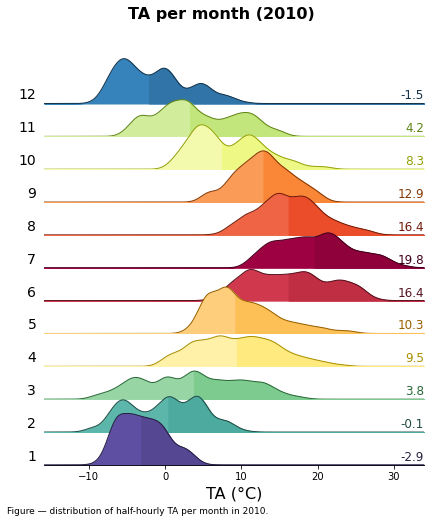
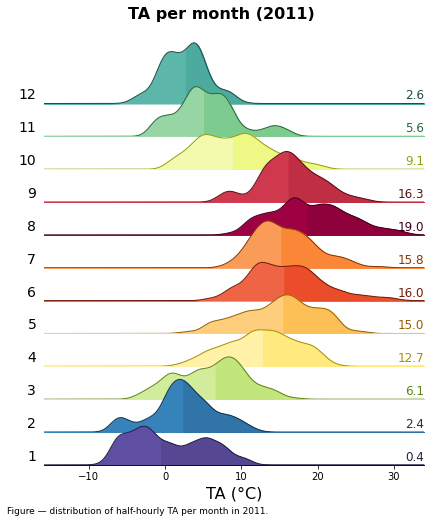
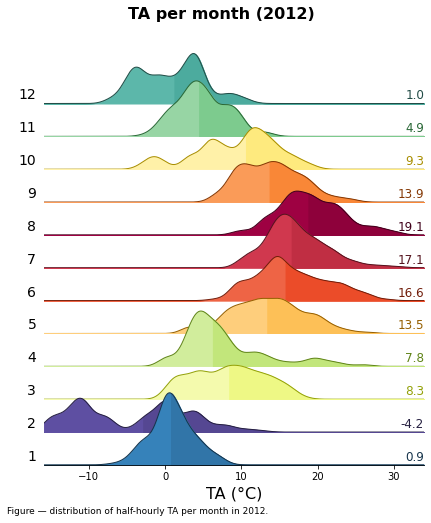
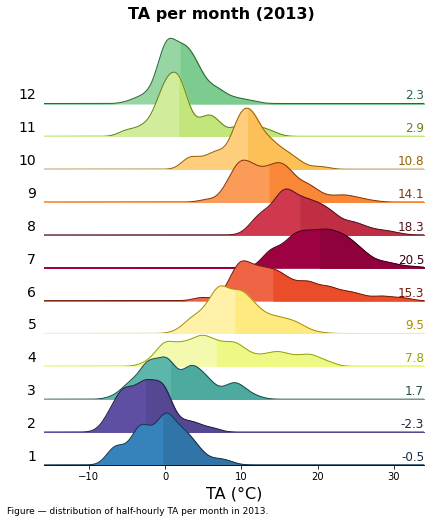
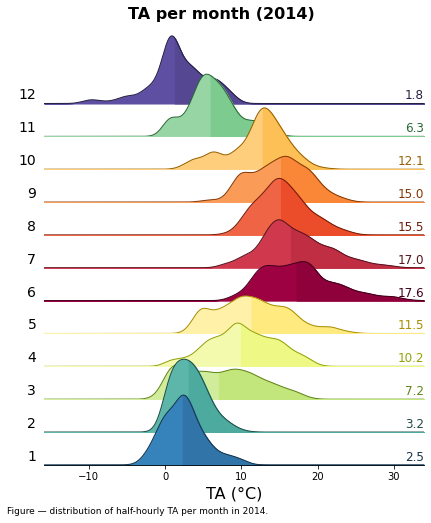
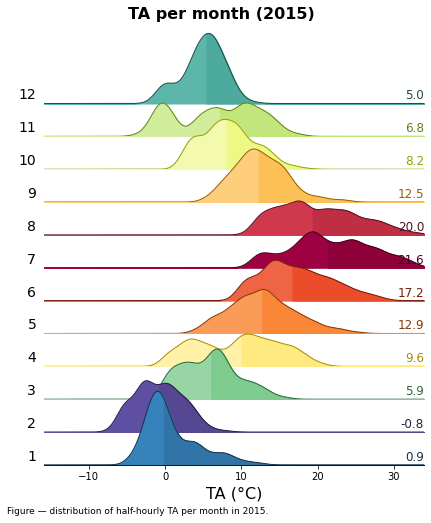
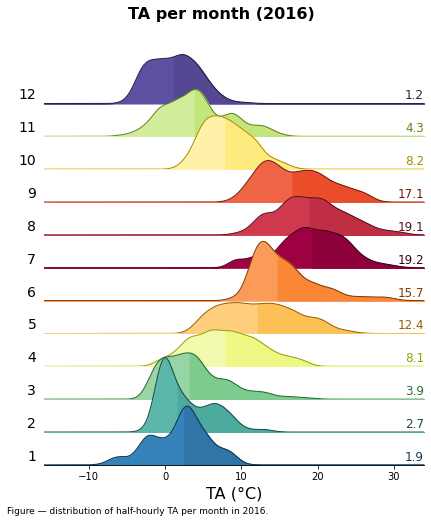
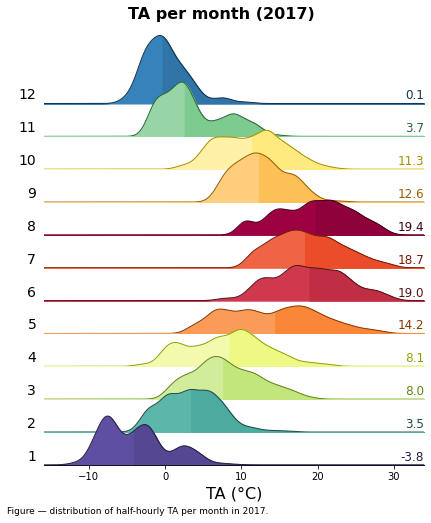
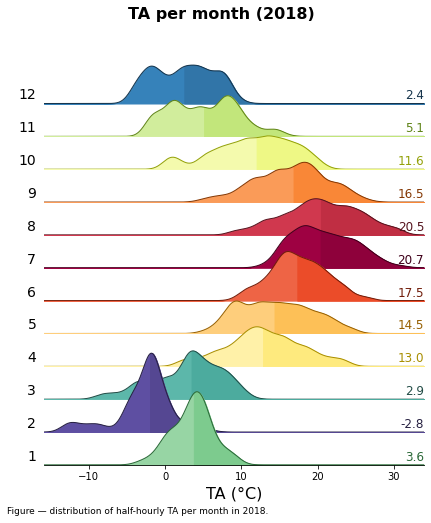
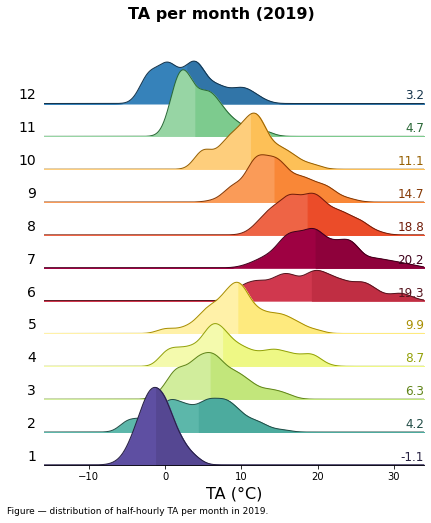
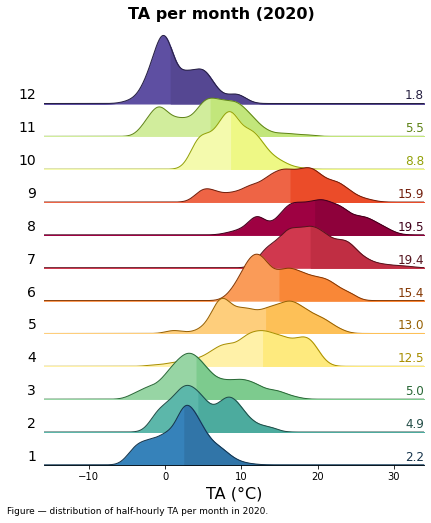
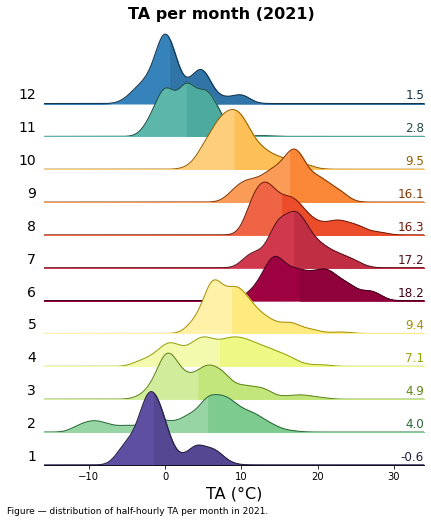
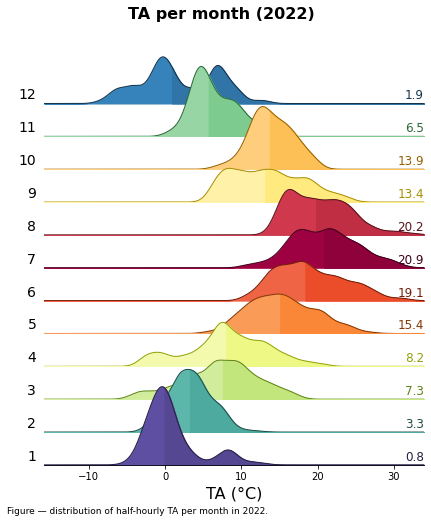
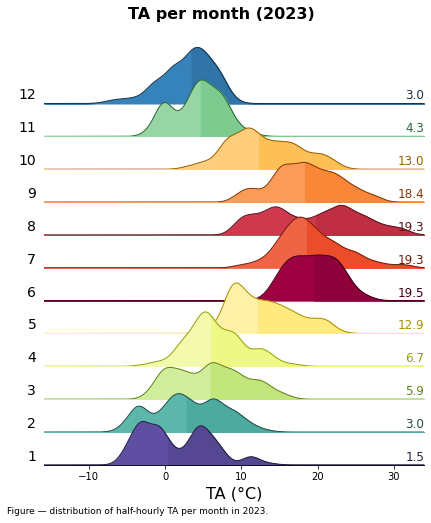
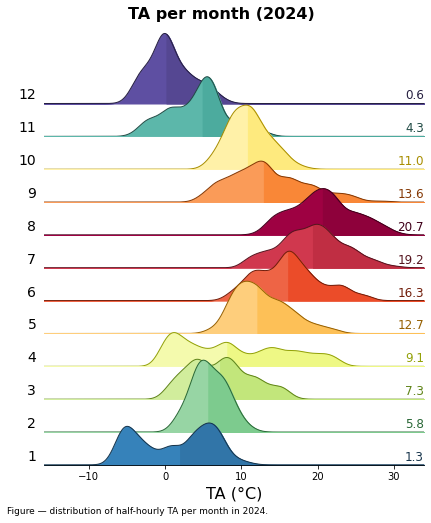
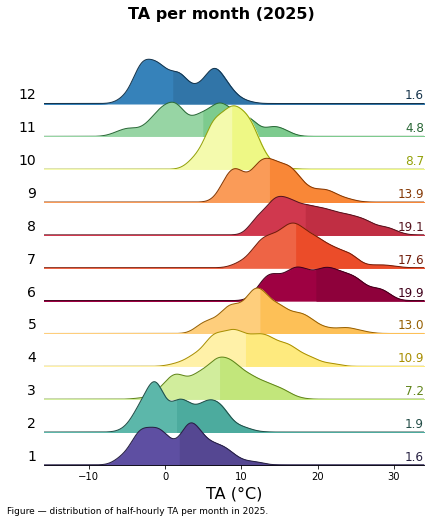
Single years per week
if SHOW_PER_YEAR_DETAIL:
    uniq_years = series.index.year.unique()
    for uy in uniq_years:
        series_yr = series.loc[series.index.year == uy].copy()
        rp = dv.plotting.RidgeLinePlot(series=series_yr)
        rp.plot(
            how='weekly',
            kd_kwargs=None,  # params from scikit KernelDensity as dict
            xlim=xlim,  # min/max as list
            ylim=[0, 0.3],  # min/max as list
            hspace=-0.8,  # overlap
            fig_width=9,
            fig_height=18,
            shade_percentile=0.5,
            show_mean_line=False,
            format_style=dv.plotting.FormatStyle(xlabel=xlabel, title=f"{var} per week ({uy})"),
            fig_dpi=72,
            showplot=True,
            ascending=False
        )
        figcap(rp.fig, f"distribution of half-hourly {var} per week in {uy}.")
F:\dev\diive\diive\core\plotting\ridgeline.py:153: RuntimeWarning: More than 20 figures have been opened. Figures created through the pyplot interface (`matplotlib.pyplot.figure`) are retained until explicitly closed and may consume too much memory. (To control this warning, see the rcParam `figure.max_open_warning`). Consider using `matplotlib.pyplot.close()`.
self.fig = plt.figure(figsize=(self.fig_width, self.fig_height),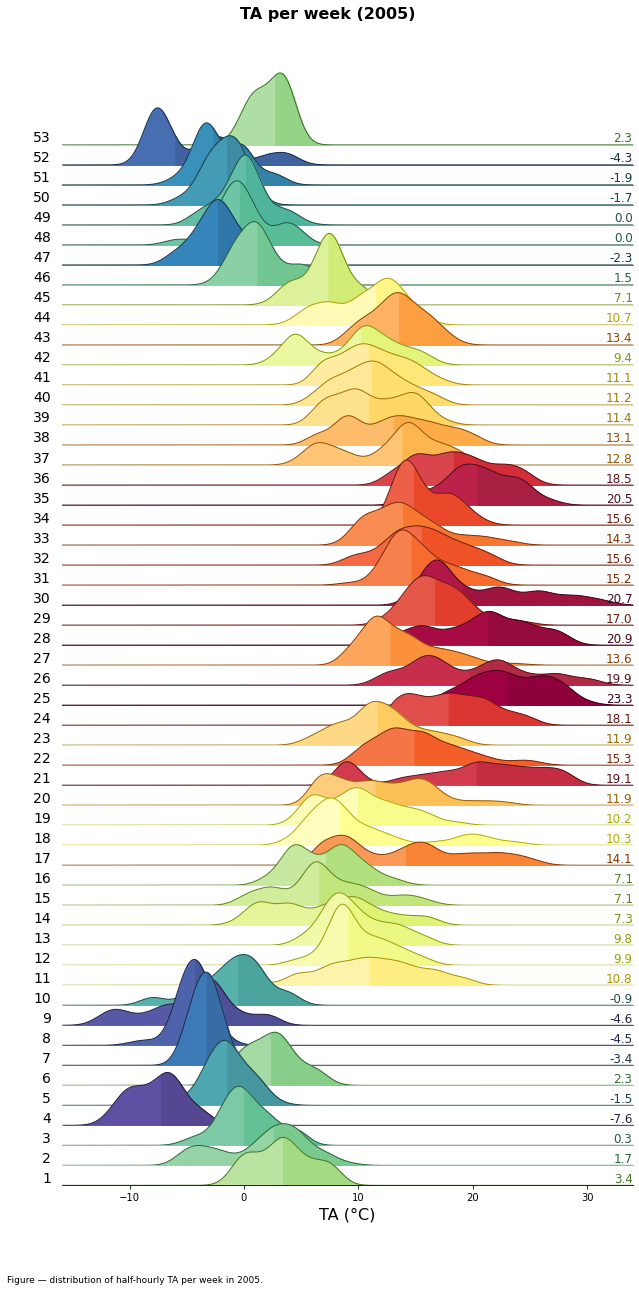
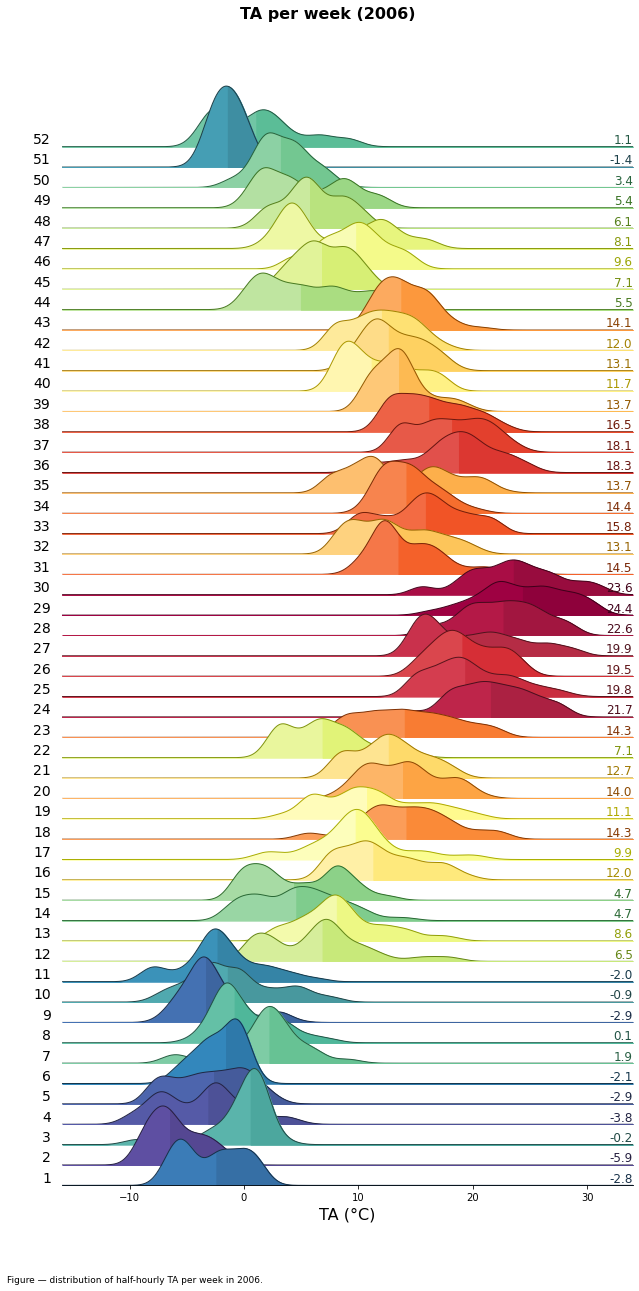
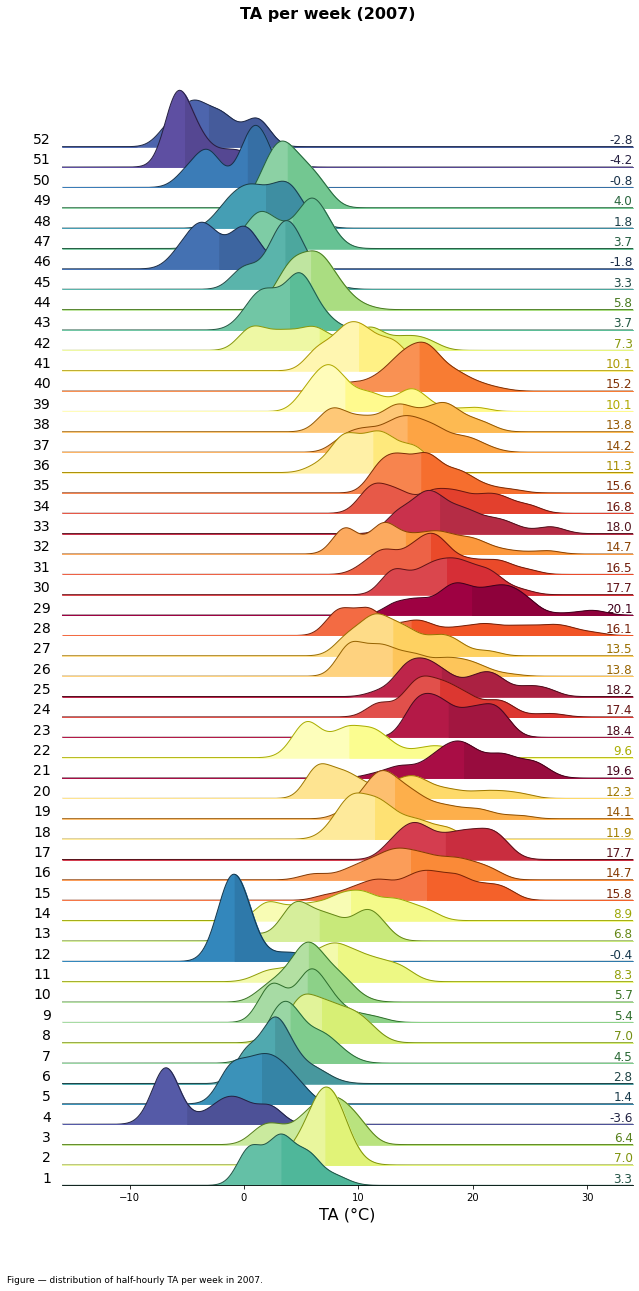
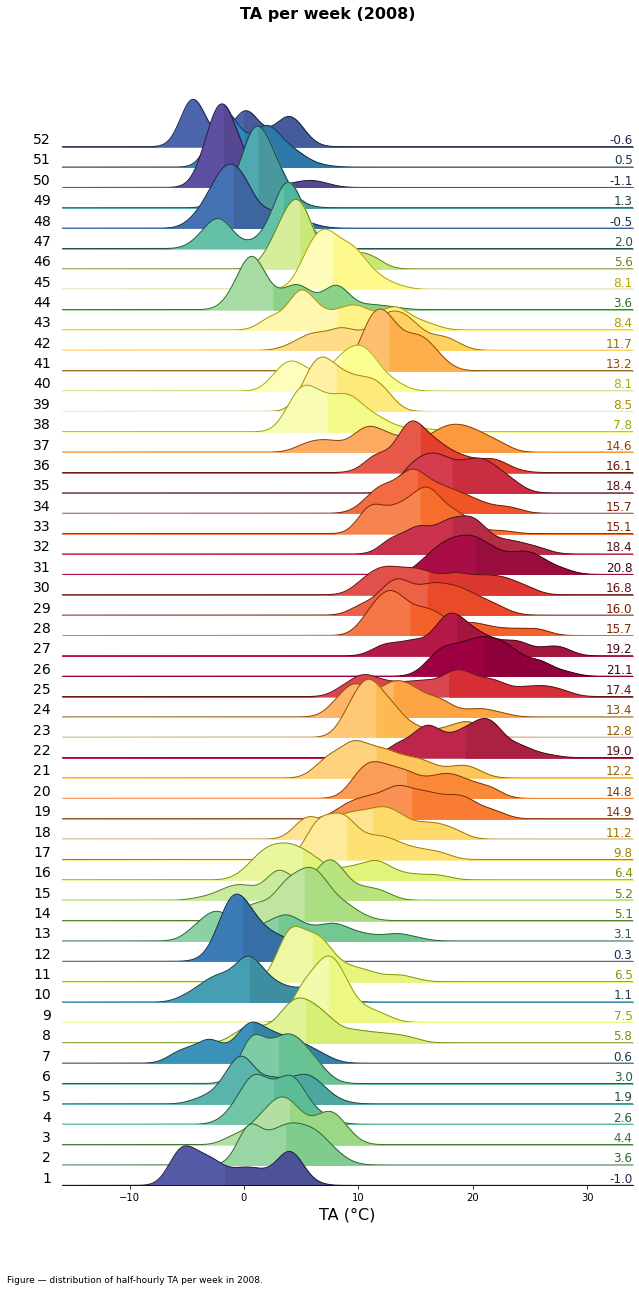
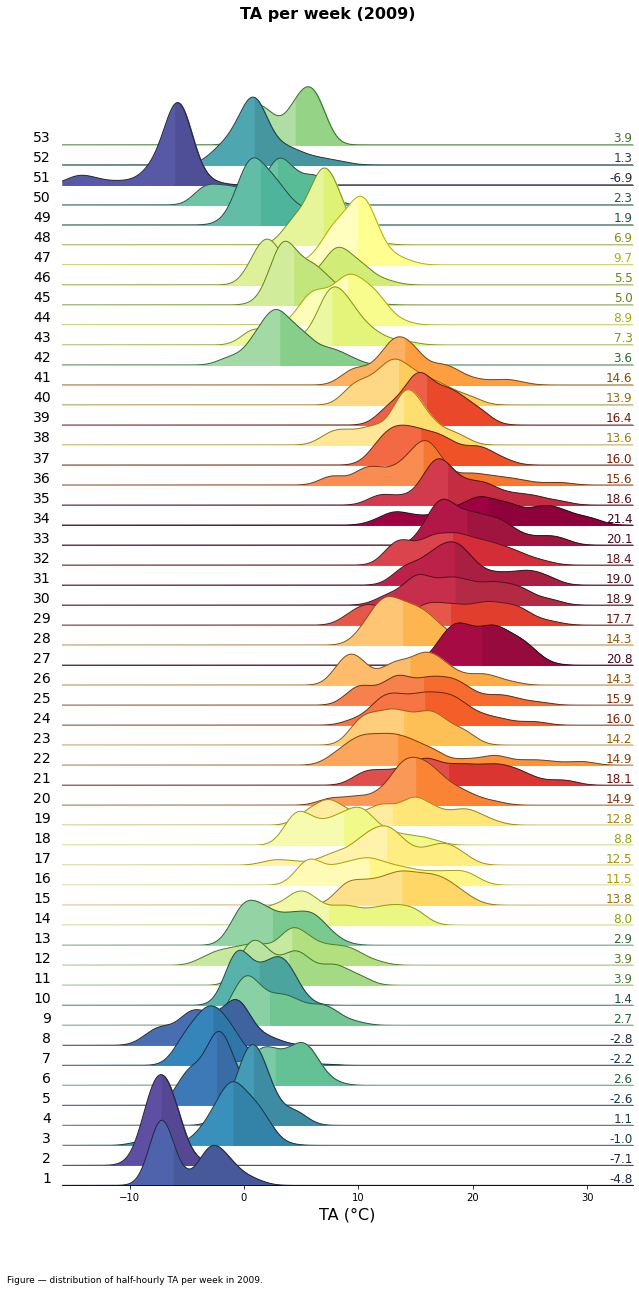
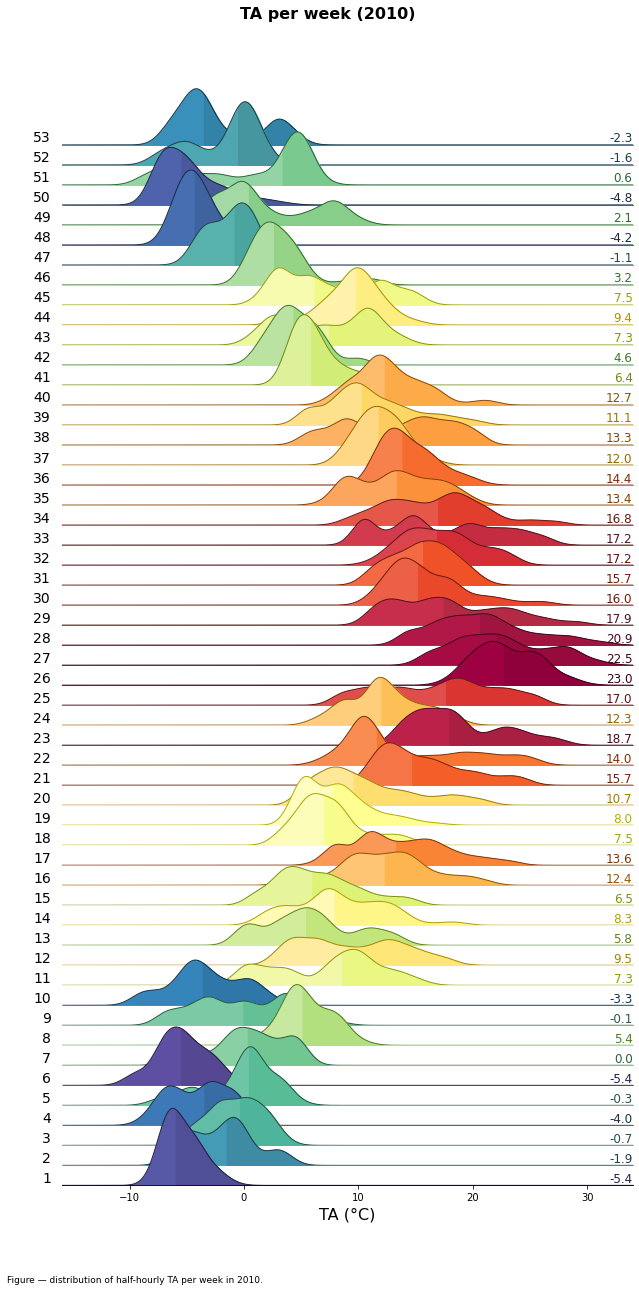
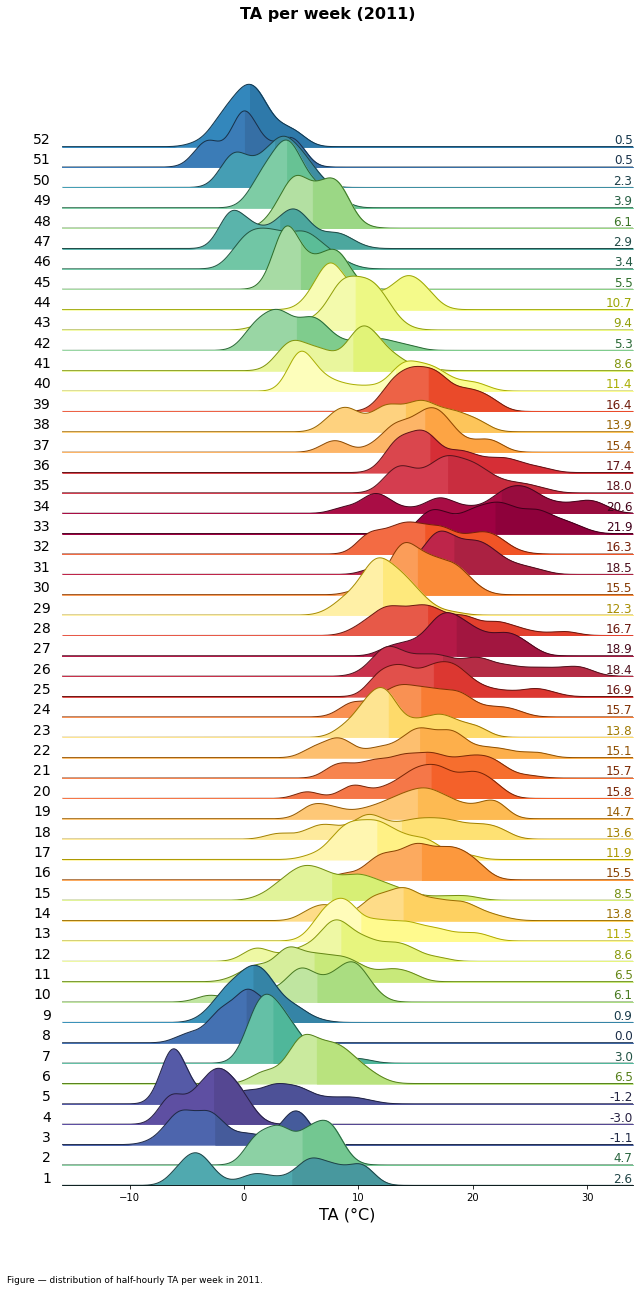
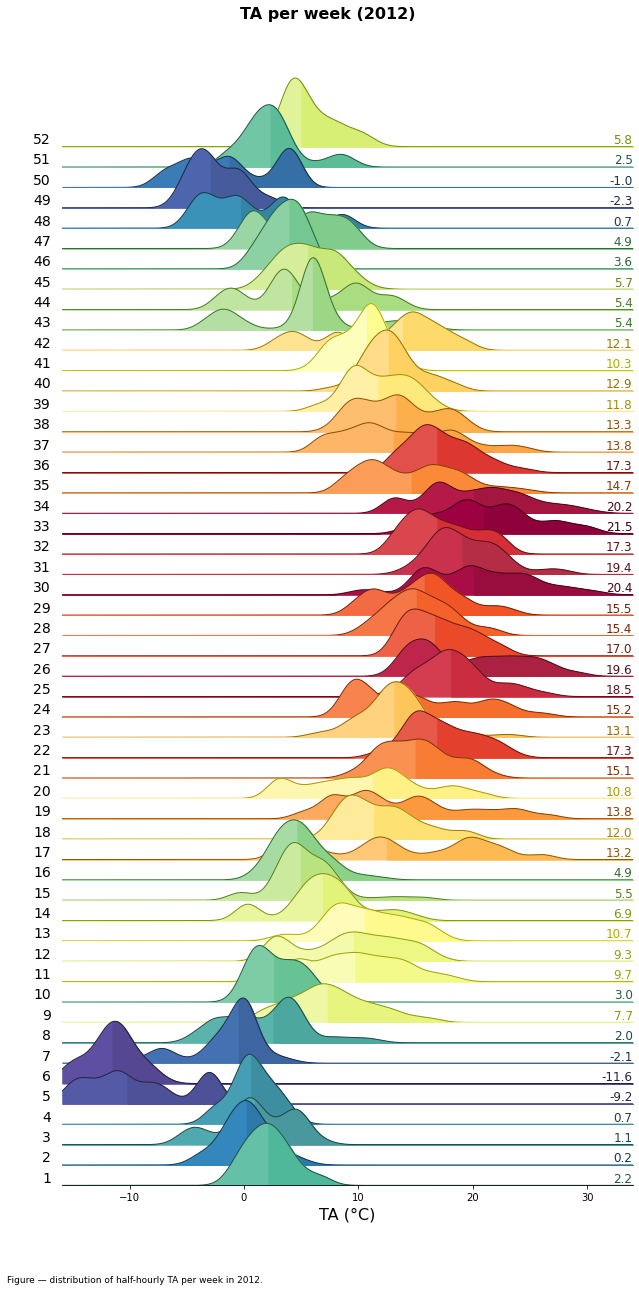
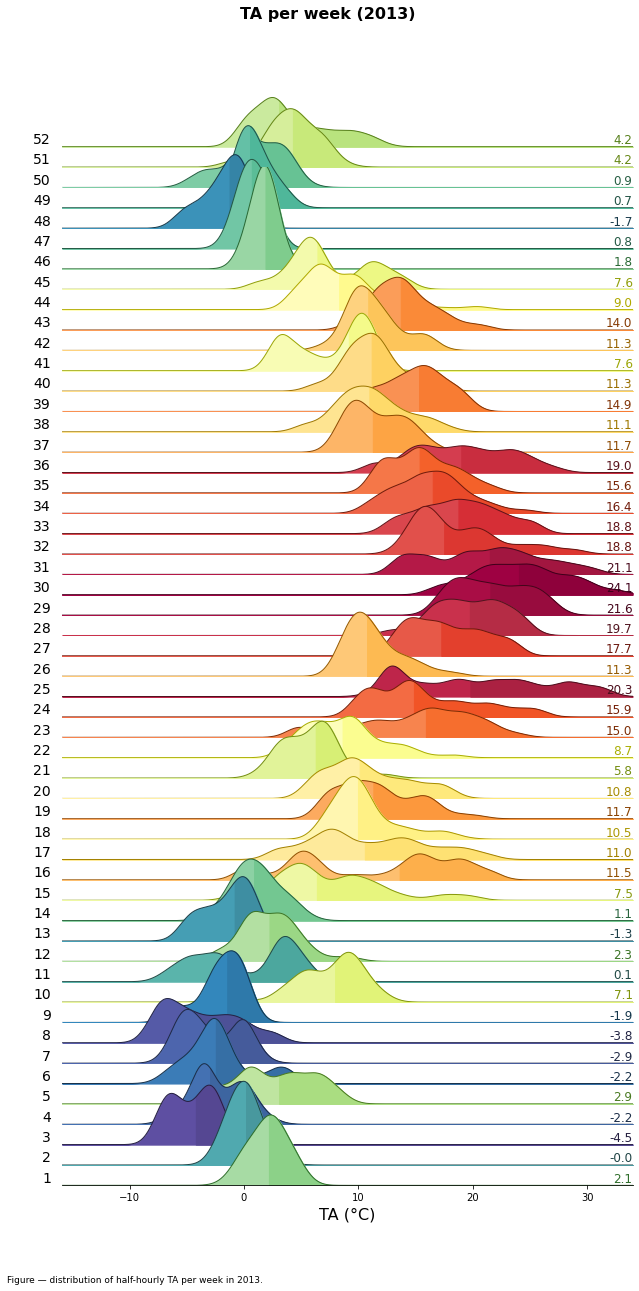
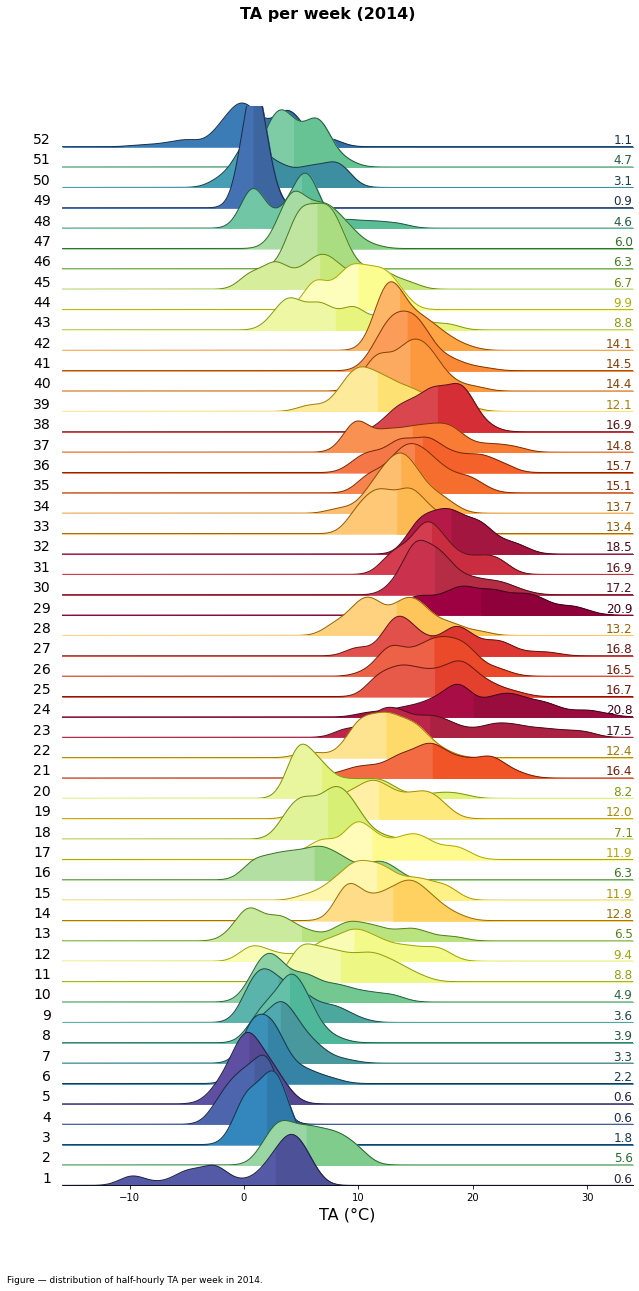
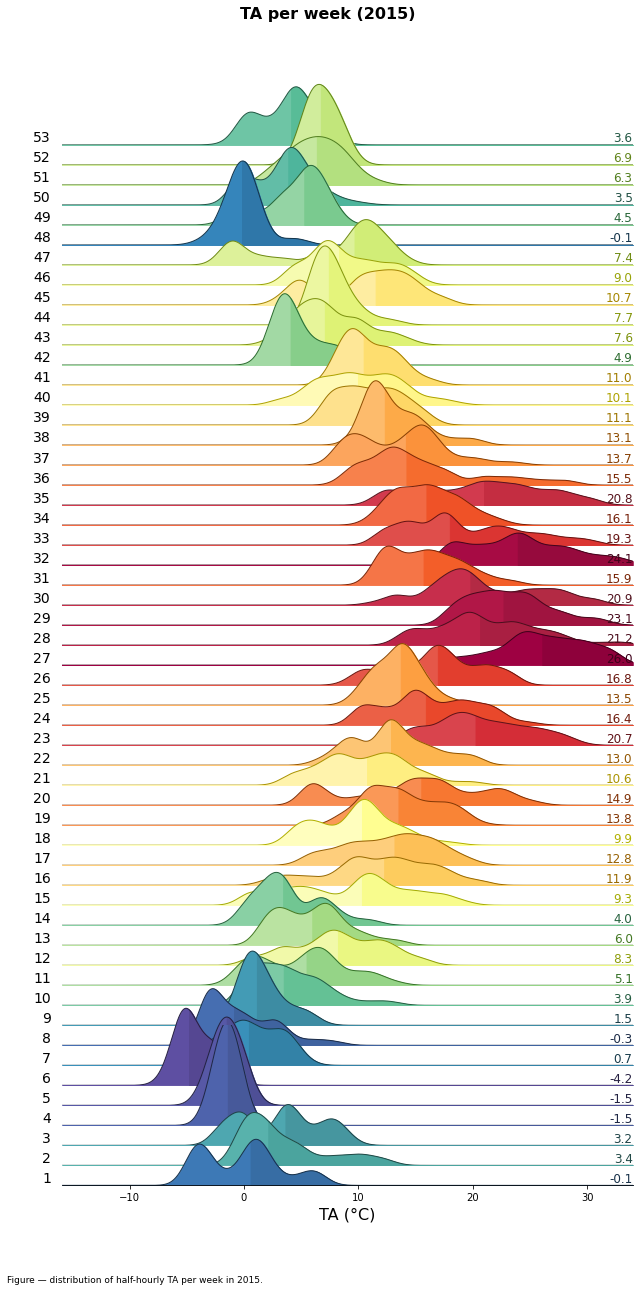
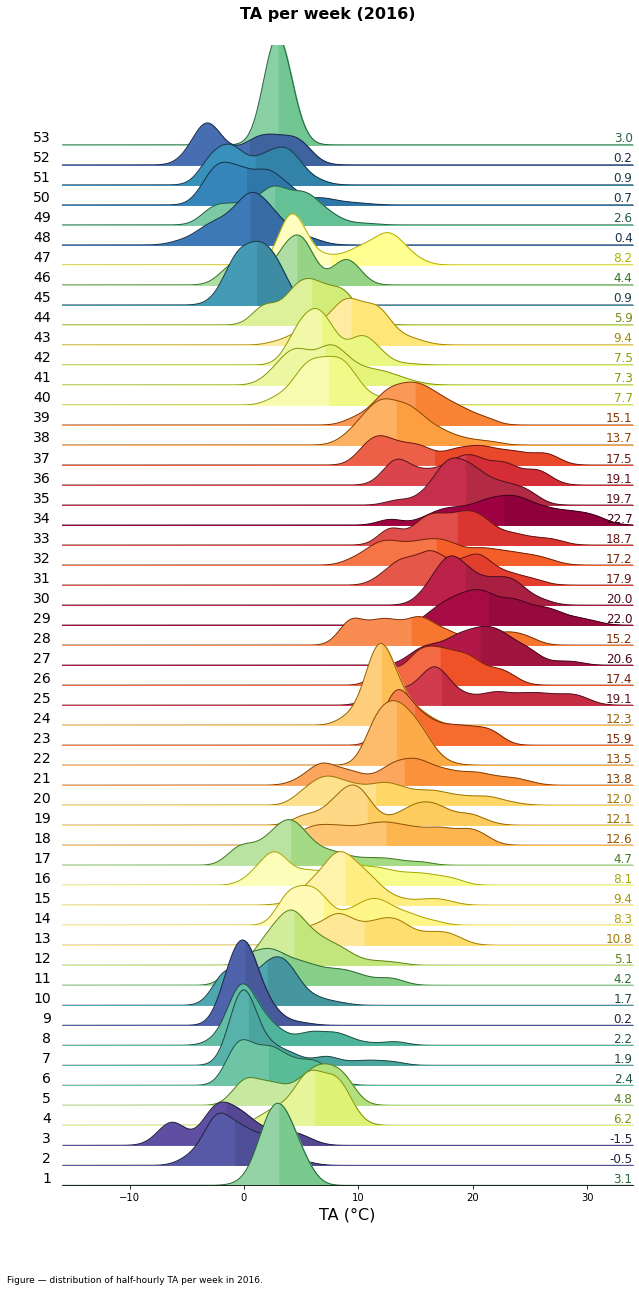
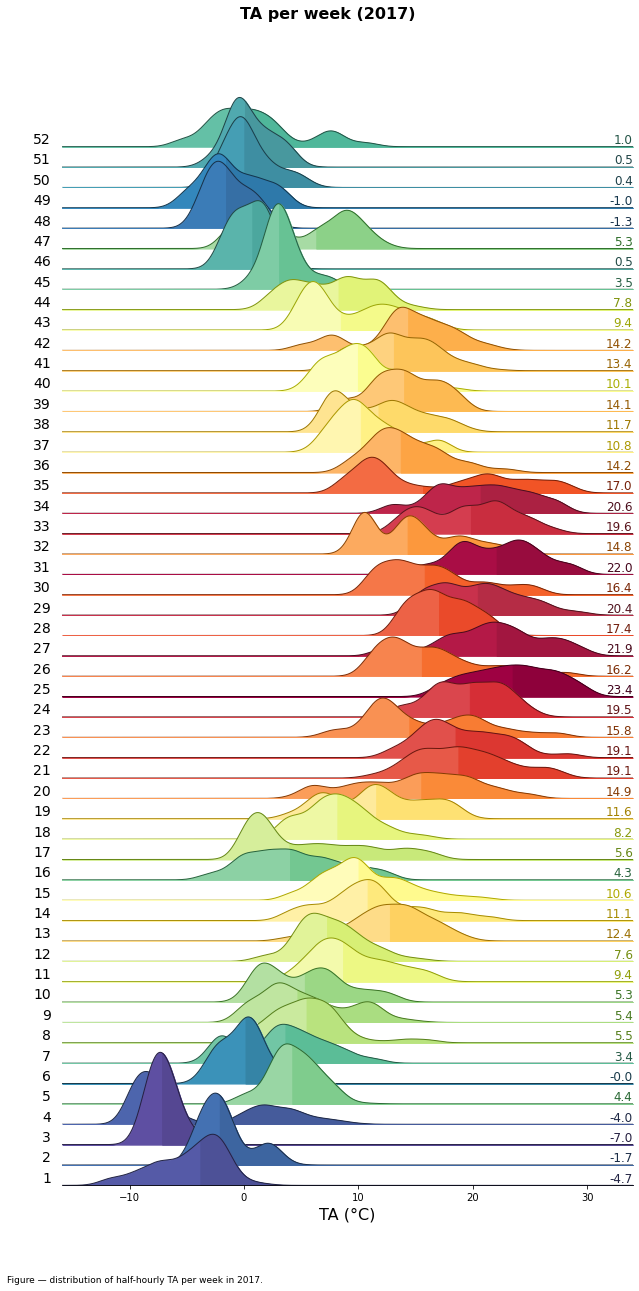
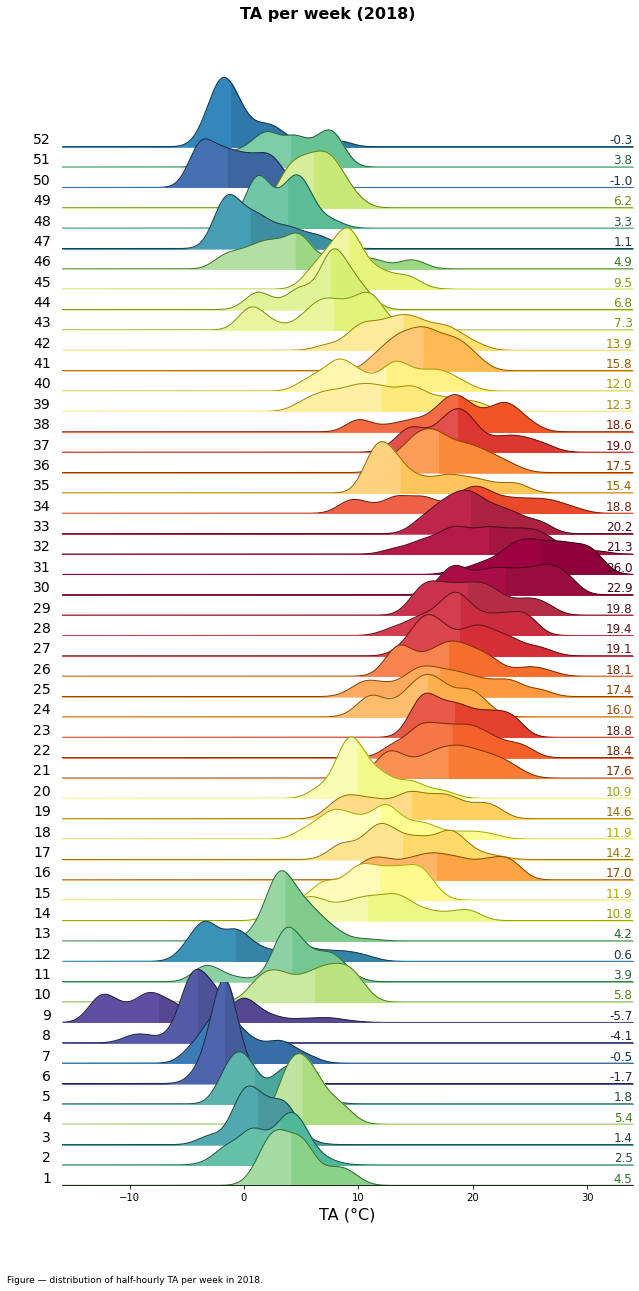
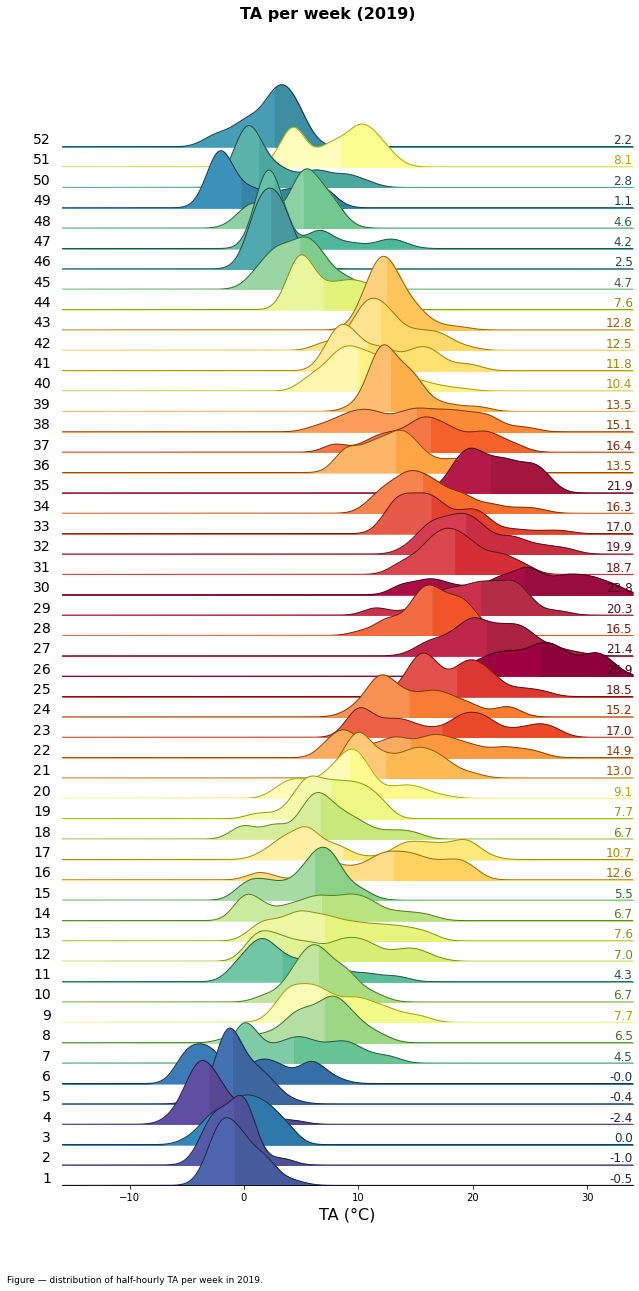
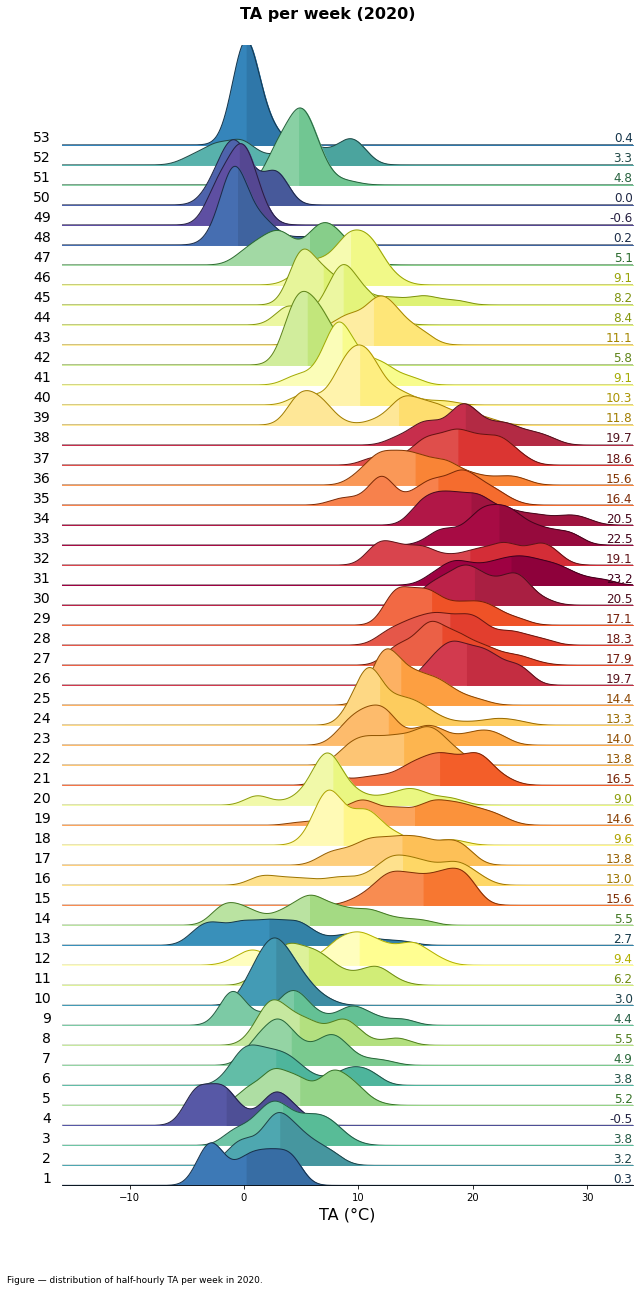
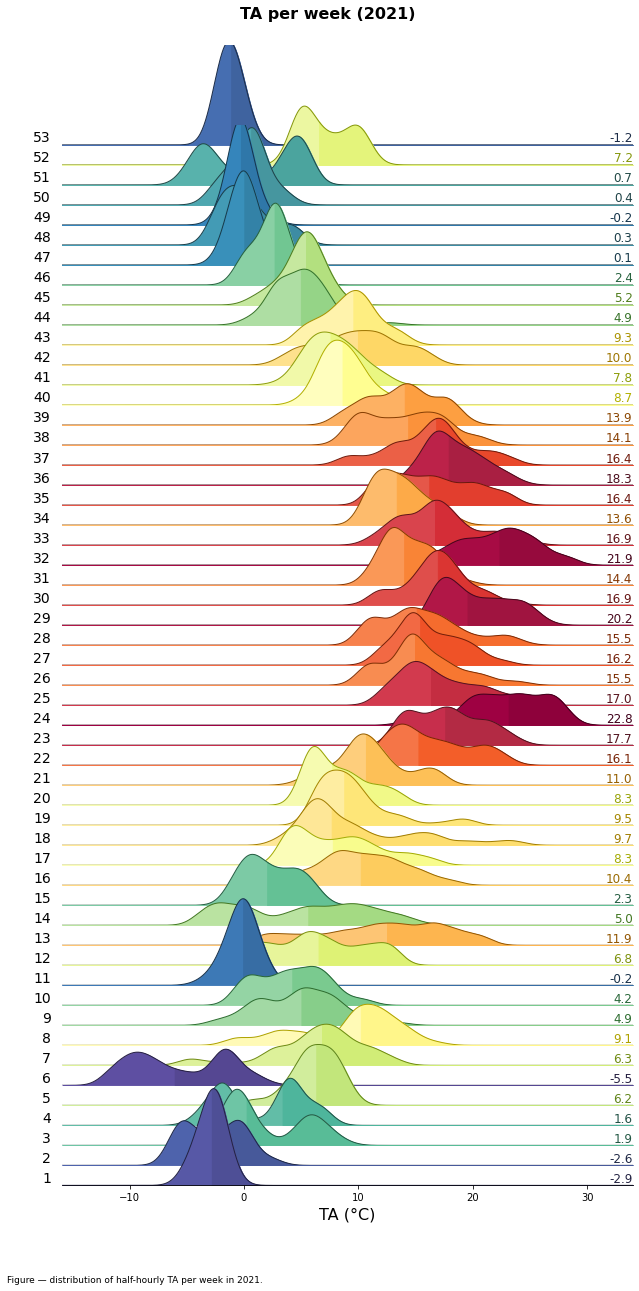
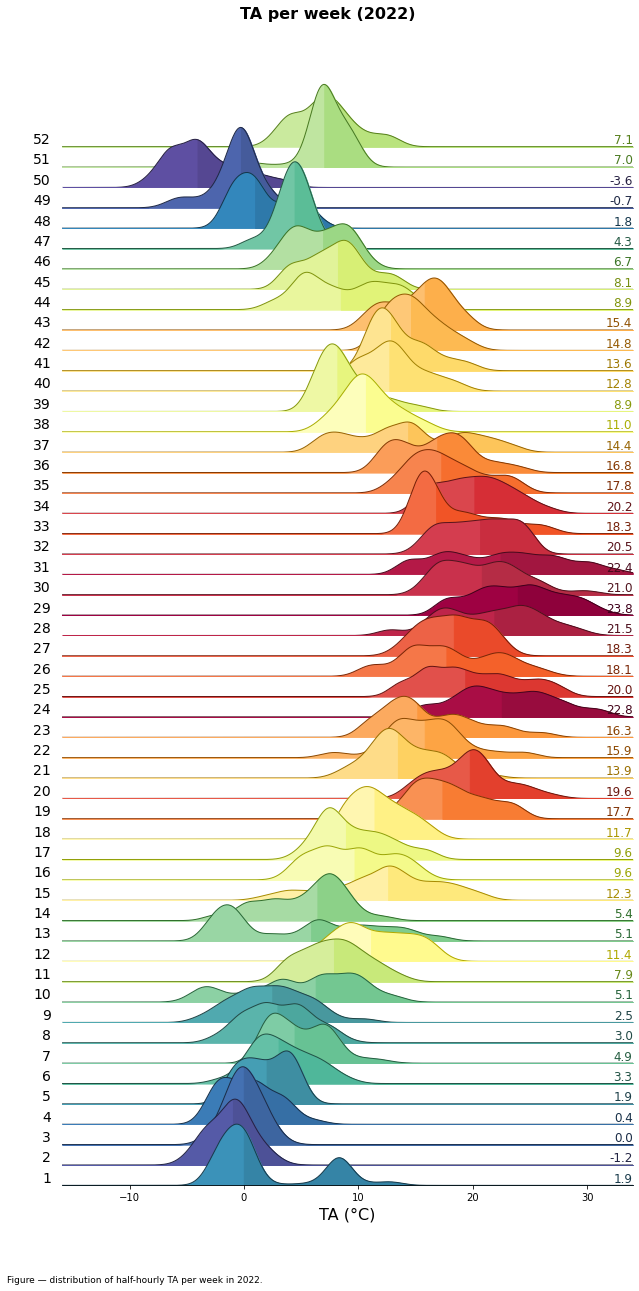
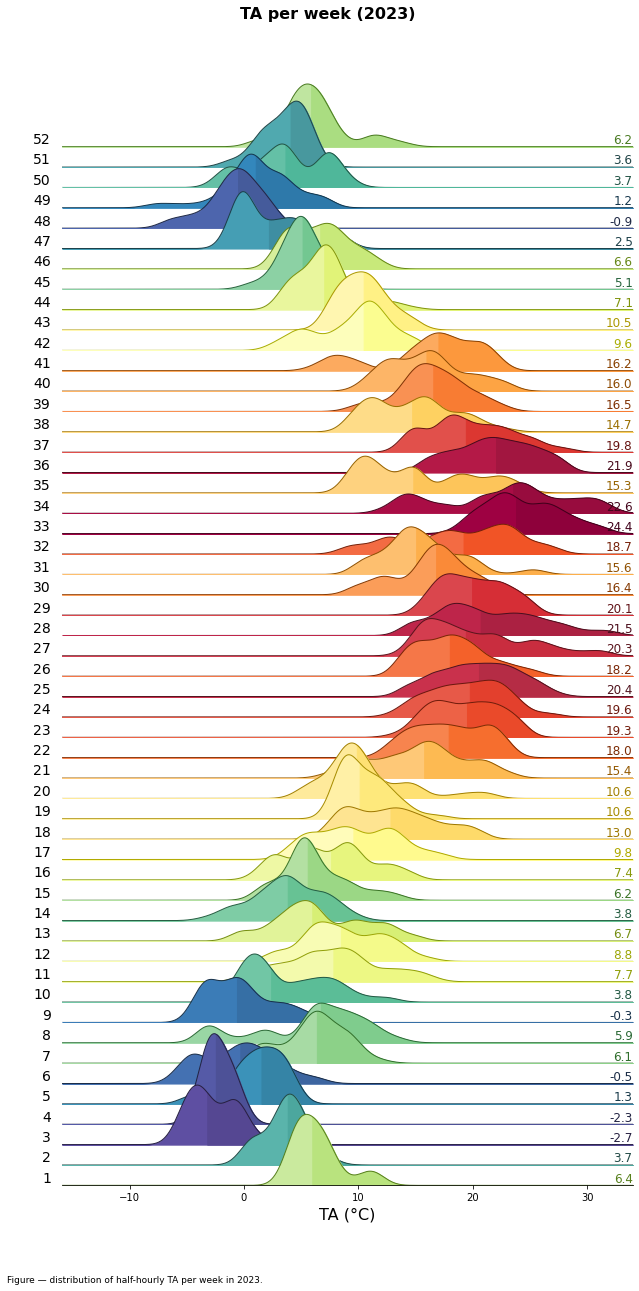
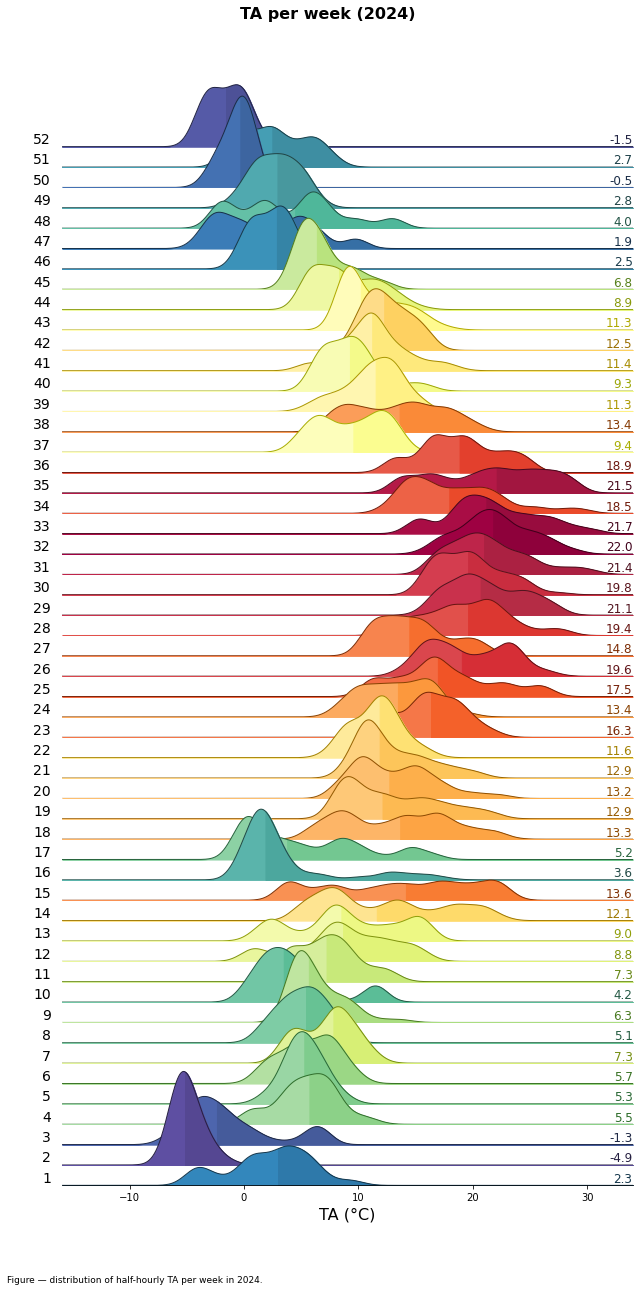
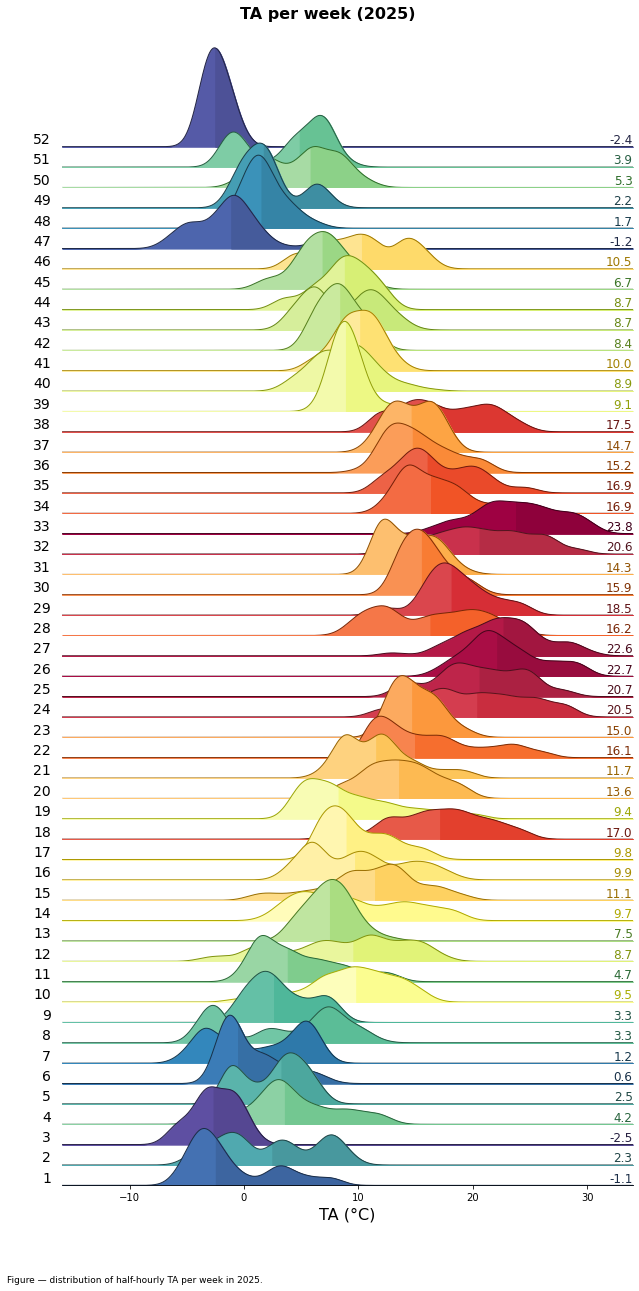
End of notebook
dt_string = datetime.now().strftime("%Y-%m-%d %H:%M:%S")
print(f"Finished. {dt_string}")
Finished. 2026-07-29 00:10:30